
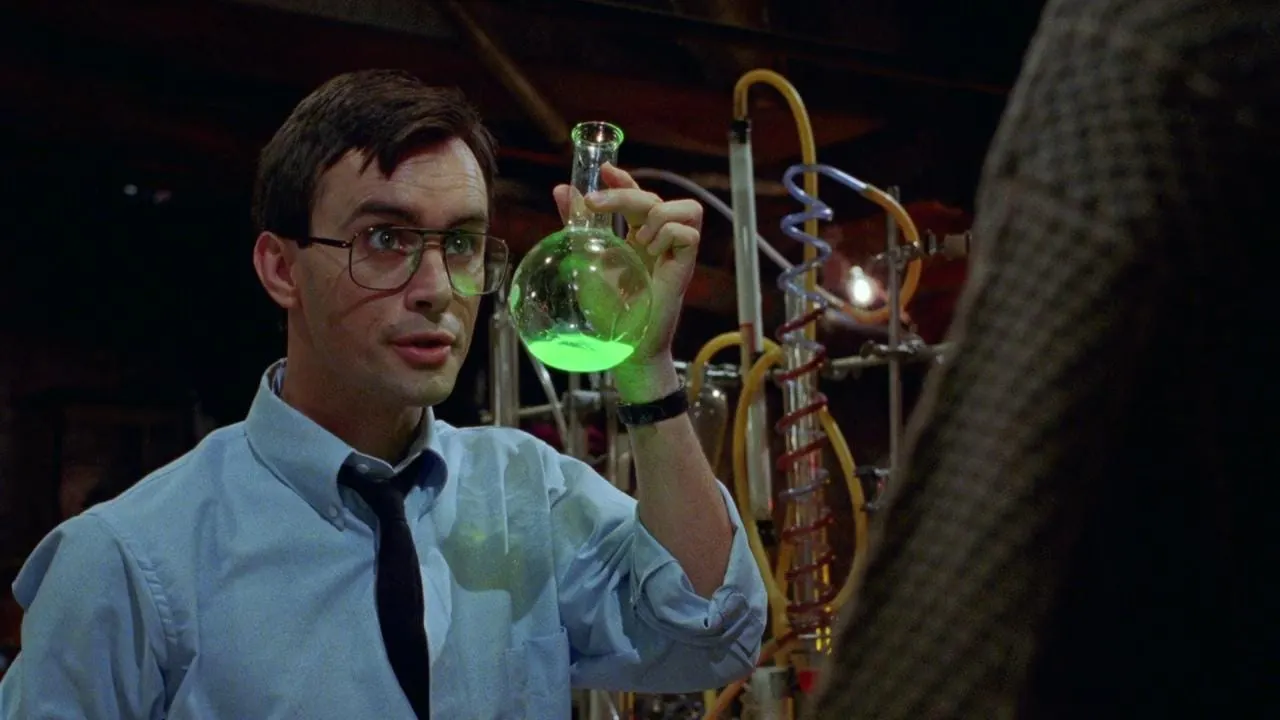
If you're a devoted horror movie fan, you've probably heard of the Re-Animator series. The series, a loose adaptation of the original written books by H.P. Lovecraft., focuses on two scientist as they attempt to perfect the process of bringing the dead back to life using a chemical known as the "reagent". It became iconic for Jeffrey Combs' portrayal of the mad genius, Herbert West, and introduced the trope of the "glowing green liquid" that's now synonymous with the mad scientist subgenre.
While the story is rather straightforward, many contend that there is nothing straight about it. Since the film came out in 1985, fans have almost unanimously decided that West is gay despite it never being said in the film. These claims were only reinforced in the 1990 sequel, Bride of Re-Animator, and have been embraced in all the comic adaptations and fan works.
But how did a story from a famously homophobic author become known as a queer romance? (It goes without saying that from here on out, there are spoilers for the Re-Animator franchise)
The original stories, "Herbert West-Re-Animator", were commissioned by George Julian Houtain for his sensationalist magazine, Home Brew, and were serialized in the issues of February to July 1922. Lovecraft was paid $5.00 a segment and was allegedly told, "You can't make them too morbid". Lovecraft considered the stories to be crudely commercial, mechanical, unimaginative, and "manifestly inartistic." However, $5 was roughly $100 by 1922 standards, so Lovecraft gritted his teeth and wrote them anyway.
The Herbert West series is universally understood by Lovecraft scholars to be his worst work. It heavily borrows from Frankenstein, it is riddled with cliches, it's ridiculously over-the-top, and it's unapologetically racist. Calling it a "well-meaning, but ultimately sloppy parody of Gothic Horror" is about as kind as one can describe it. There are whispers of queer coding in these stories despite the author being literature's most famous bigot.
The Narrator (later adapted into the character of Daniel Cain) frequently makes note of West's "pale blue eyes" and "soft voice". He describes himself as West's "closest companion" and his "inseparable assistant" on multiple occasions.
At the beginning of the series, the narrator notes how they had to carry out their experiments in secret since they weren't acceptable by society's standards. The pair spent almost 20 years at each other's side, living together and attempting to create life. The Narrator notes several times how they have to hide their experiments in abandoned farmhouses or remote cottages because society doesn't accept their theories. It's not hard to assign queer subtext to such a lifestyle.
At one point, it is even noted that West is more interested in reanimating men with "especially vigorous physiques," and that as West descends into madness, he begins to look at the Narrator in the same way he looks at muscular men.
If that wasn't enough, essayist Raine Petrie makes the observation that the Narrator uses "verbiage eerily similar to Lovecraft’s descriptions of homosexuality when describing West, stating that his interests 'became a hellish and perverse addiction to the repellently and fiendishly abnormal'."
Although it was certainly unintentional, there is certainly a queer undertone to the racist pastiche that is "Herbert West - Reanimator."
In the early 80s, playwright Stuart Gordon was looking for a horror story to adapt for his first film script. He was tired of vampire movies and wanted to write something like Frankenstein. So when his friend recommended a lesser-known work of Lovecraft, he knew he had his story. Ultimately, "Herbert West - Reanimator" is a Kirkland brand Frankenstein, so it's understandable that Gordon saw potential there. Gordon borrows a few character names and the basic concept and, thankfully, completely reimagines the story from there.
Then came 1985's Re-Animator. In this version, the unintentional queering of Hebert West is only further explored. In this version, the Narrator is given the form of Daniel Cain. One of the most notable differences between these two characters is that Cain is engaged to a woman named Megan Halsey, who hates Herbert West and his theories of reanimation. Nonetheless, Cain seems to be entranced by West's theories and experiments, agreeing to be his lab partner. The movie has Halsey constantly telling Cain that West will ruin his life with his mad theories, while West is jealous of Halsey, feeling as though she's distracting Cain from their research.
If we accept the theory that West's experiments are a metaphor for homosexuality, then the story here becomes clear. Cain is drawn away from his normal life and his fiancée by West's dark path of gay love. Halsey is worried that she will lose Cain to this, and he will ruin his own life. While West is jealous that Halsey can have Cain in the daylight hours, and that she doesn't have to hide her love for him.
This interpretation of the movie has existed since its release, but the sequel, Bride of Re-Animator, took these themes to a whole new level.
Bride of Re-Animator picks up 8 months after the end of the first movie. West and Cain have graduated from medical school and now live together after serving as medics in Peru's civil war. The first thing worth noting is the way the two bicker like an old married couple, whether it be over mundane household tasks or the nature of their experiments.
Similar to the plot of Lovecraft's tale, Herbert West is no longer interested in reanimating the dead. He has already proven he can do that. Now, West seeks to create a new life with Daniel Cain. A creature born purely from the fruits of their labor using a modified version of the reagent.
Cain, on the other hand, wants out. He's in mourning after his fiancée died at the end of the first film and wants to quit being West's partner. He met an Italian journalist named Francesca Danelli during the war and now muses over the idea of moving on from his grief and attempting a normal life. A life apart from Herbert West.
Now, if West were truly the cold, calculating mad genius that he presents himself as, he wouldn't care. After all, who cares who is acting as his assistant so long as the research continues? This, however, is not the case. Herbert can't stand the idea of losing Daniel.
Sensing that Daniel is starting to pull away, West breaks into the morgue and retrieves Megan Halsey's heart. When Daniel attempts to break things off, Herbert West asks him, "Which part of Megan did you love?" West presents the heart, and proposes that they create a new version of Megan. A woman built purely to love Daniel Cain, using Megan's heart.
West wants to create a new life with Daniel. In his own twisted way, Herbert West wants to start a family with Daniel Cain. And he proposes this by literally offering a heart. Herbert cannot outright express his love for Daniel, but he can create a being whose entire existence will be devoted to loving Daniel.
The movie continues with Herbert West collecting the parts necessary and experimenting to perfect the process of fusing parts to create a new being. Meanwhile, Daniel begins to date Francesca and, as you might expect, West is jealous of the time he spends with her. In one particularly noteworthy scene, Daniel and Francesca are engaged in coitus before cutting to West, who continues his experiments in the basement below them. Herbert fuses the leg of a woman to the arm of a man as he takes occasional, frustrated glances up to the ceiling, knowing that Daniel and Francesca are together just two floors up. The man-woman arm-leg creature attacks West before he tosses it into a trash bag.
One could read the significance of this scene as West attempting to understand the nature of heterosexual love before being attacked by the physical manifestation of a man and a woman being together.
West spends the majority of the movie taking great care in selecting body parts that he believes Daniel will find the most appealing. Most noteworthy, he steals the head of a patient whom he knew Daniel had a special connection with.
Finally, in the third act, Daniel and Herbert come together to bring their "bride" to life. The scene has an oddly sensual nature to it. Herbert West speaks in a soft, low voice as he describes the various parts of the bride to Daniel. When it's time to bring the bride to life, West goes to inject the reagent, but Daniel stops him. "Let me," Cain says. West's face fills with shocked excitement. This is a noteworthy change from the source text, as in Lovecraft's version, West is noted as never letting anyone else administer the reanimator serum. In this version, however, West is excited at the prospect of Daniel taking part in the creation of this manifestation of his love.
I could go on for probably 2,000 more words about all the ways a queer interpretation works for Bride of Re-Animator and its predecessor. However, despite all these glaring metaphors, director Brian Yuzna rejects this interpretation:
"So, yes the subtext is not off the charts. But. But. I will refute this once and for all. In my world, for West science is sex."
He states that Herbert West might be queer in the sense that he yearns for companionship in the form of Daniel Cain, but is otherwise asexual. Yuzna also notes that Daniel Cain cannot be queer as he likes women. This obviously ignores the existence of bisexuals, but I digress.
Whether or not the director intended it or even agrees with the concept, the fandom has long since embraced Herbert West as a queer villain. In subsequent comics exploring his adventures, it is either heavily implied or stated outright that West is homosexual. Not to mention the plethora of fan fiction and inspired works that place Cain and West directly in a relationship.
So let H.P. Lovecraft roll in his grave. After less than a century, his most hated work, which sloppily rips off Mary Shelley, has evolved into a tale of two men who must lead secret double lives in a society that views their love as an act against God.
To paraphrase Herbert West after the Bride comes to life: "Before a God that is repulsed by the very humanity he has created, the only blasphemy is to wallow in insignificance."


