Table of Contents
Key Takeaways
- Jennifer Gouchoe’s semi-autobiographical short film Fix the Faucet explores personal chaos through dark comedy and intimate storytelling.
- The filmmaking process involved intense rewriting and editing to heighten stakes and sharpen narrative flow, showcasing the power of collaboration.
- Independent filmmaking thrives on community and resourcefulness, with Gouchoe emphasizing the importance of a dedicated creative team.
Dark comedy filmmaker Jennifer Gouchoe returns with her directorial debut, Fix the Faucet, recently featured at TRC Shorts Fest.
Starring Gouchoe herself alongside Kelley Poling and Johnny Visotsky, the film unpacks the humor and anxiety of a young woman’s chaotic life in Los Angeles.
Produced by Emma Steiger and shot by DP Taylor Balfour, Fix the Faucet blends vulnerability and wit in a story about confronting personal and emotional leaks.

What drew you to make this film? Why this story, and why now?
My kitchen faucet was actually leaking — not for two months and 17 days, but long enough to become concerning — especially after my plumber ghosted me several times. I was playing tennis with Taylor, my friend and DP, when I told them about my toxic relationship with my plumber. Their immediate response: “Write a short film about it, and I can shoot it.”
I wrote the first draft in a fever dream one night, uncovering my real-life faults and deepest insecurities. The kitchen faucet leaking was one problem on a list of many that I had been ignoring for far too long.
Fix the Faucet became a journey of self-discovery. It occurred to me that if I made a film about not being able to clean my car, end my sticky situationships, and yes, fix my faucet, maybe I could conquer those quests in real life.
"Fix the Faucet became a journey of self-discovery."
What surprised you most about the filmmaking process this time—creatively or logistically? Was there a moment on set or in post that completely changed how you saw the story?
This was my first time directing a short. I had rewritten the script several times over the course of eight months before saying, “Okay let’s shoot it now.”
Post-production was a whole other beast — it was my first real lesson in “editing is rewriting.” I worked very closely with my beloved editor, Harrison O’Clair, and we kept finding places in the story that worked on paper, but didn’t land in the edit. The film became a puzzle that we had to rearrange, reconstruct, and rewrite.
One common note throughout post-production was that Violet’s struggle didn’t feel real enough. We needed to raise the stakes and amp up the chaos. We found one scene in particular that stopped the momentum of the film: a scene in which the plumber answers Violet’s call. I said to Harrison, I think we need to kill some darlings. We cut the scene, I rewrote some new VO, and the film flowed much more smoothly.

Is there a moment in the film that feels the most you—something only you could have made?
The split screen in which the four male actors say, “You can order new hubcaps on Amazon” and the subsequent split screens of the guys. It feels like a perfect representation of my sense of humor.
"It’s okay to not have everything figured out... we’re not here on this earth to be perfect."
What was the hardest creative decision you made while making this film?
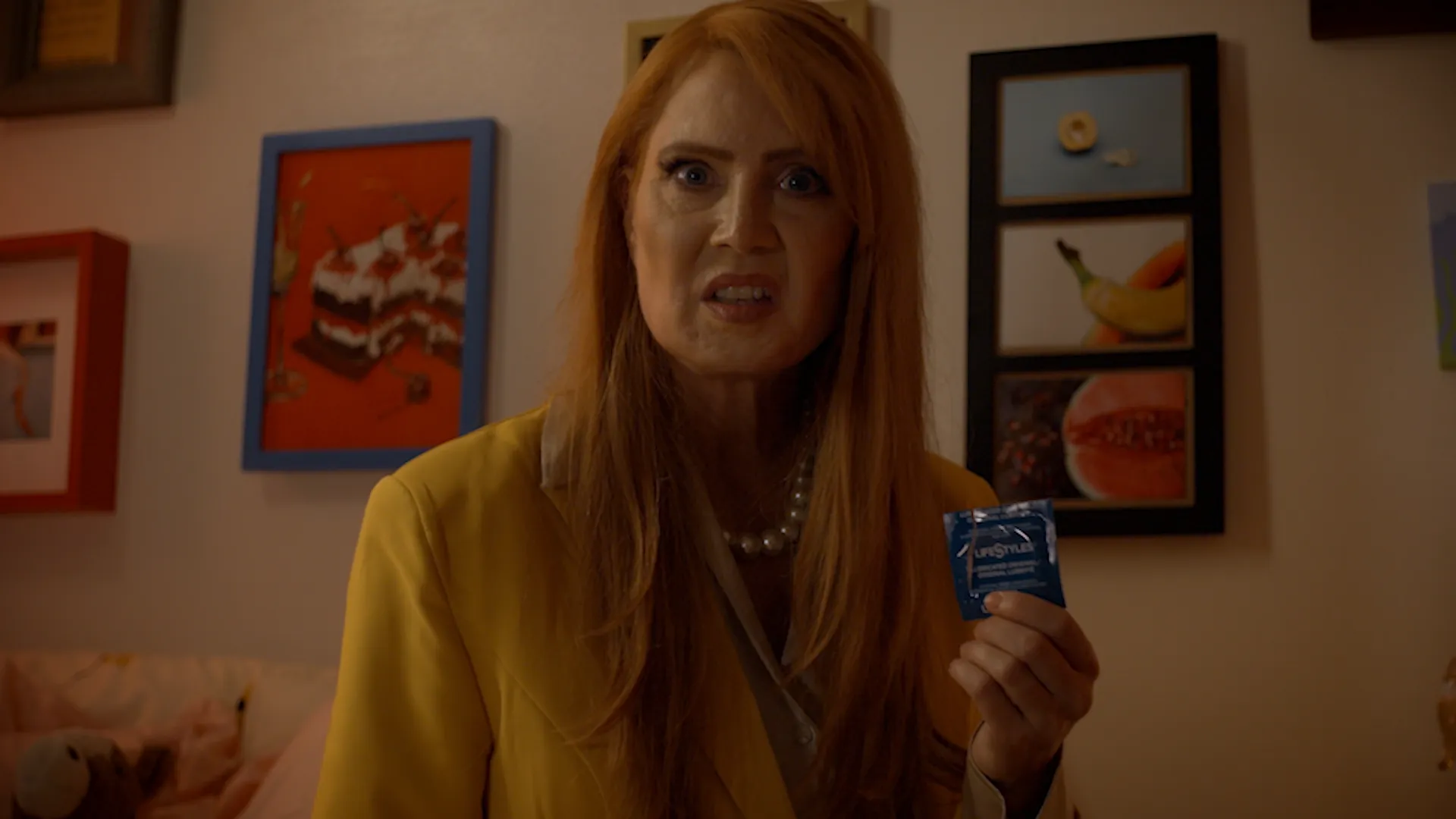
We were two weeks out from filming and we still hadn’t cast Violet’s mom. I needed someone who looked like me and who could deliver that New York, no-nonsense energy. It was looking grim — if we didn’t find someone, we would need to push filming.
Then, my dear friend and member of my glam squad, Jaya, connected me with Kelley. After one phone call, it was a done deal. Kelley absolutely killed it and was incredible to work with.
"Community is the greatest strength of independent filmmaking."

What do you hope audiences take away from your film?
It’s okay to not have everything figured out. It’s easy to let our insecurities and shortcomings define our lives, but we’re not here on this earth to be perfect. We can always strive for a little bit better every day, but it’s okay to be a little messy.

How has this film shaped or shifted the kind of stories you want to tell next?
This film has really helped me hone my voice, style, and brand as an artist. I’ve always been interested in writing dark comedies and stories about romantic relationships (often failed romantic relationships). While Fix the Faucet is more slice of life, I think it’s helped me become more specific about the stories I want to tell.
After the first screening of Fix the Faucet, I had a few people ask if I would turn it into a feature. It hadn’t occurred to me — but then I started thinking, “Huh, well, I’ve always wanted to write a rom-com…” I’m now expanding the Faucet universe and writing a feature-length version.
"Directing a film in which I was acting in nearly every scene was a challenge. I am beyond grateful for Emma, Tia, and Taylor — they were my second set of eyes behind the monitor."
What’s a tool, technique, or resource that really helped you during production?
Directing a film in which I was acting in nearly every scene was a challenge. I am beyond grateful for Emma (producer), Tia (first AD), and Taylor (DP) — they were my second set of eyes behind the monitor to help me with any acting adjustments, especially since I wasn't able to look at playback after every take.
Independent filmmakers often rewrite the rules out of necessity. What do you think is the greatest strength of independent filmmaking, and how did you lean into that on this project? Is there a lesson or breakthrough you’d share with others navigating this path?
Community is the greatest strength of independent filmmaking. Finding artists who share similar artistic visions, who are willing to be scrappy if necessary, that’s what it’s all about. Having to work under the constraints of a shoe-string budget forced us to make tough decisions, but it also helped everyone lock in. That’s the beauty of independent filmmaking — you learn to operate under pressure.
The best lesson: find your team of people who love making art for art’s sake and stick with them. I’m so lucky to have had an incredible team dedicate their time, talents, and energy to this project, and I couldn’t have made it happen without them.
"After the first screening of Fix the Faucet, I started thinking, ‘Huh, well, I’ve always wanted to write a rom-com…’ I’m now expanding the Faucet universe."

What does it mean to you to have your film selected for TRC Shorts Fest?
It’s an honor to be selected by a festival that uplifts and supports female and non-binary filmmakers. This industry is of course challenging to break into, but it’s inspiring and motivating to know there are communities like TRC that dedicate their time to help independent filmmakers get their voices heard.

Where do you see this film going next?
I’d love to screen Fix the Faucet at a festival in New York. I’m originally from Connecticut, so it would be a dream to have my family be able to come to a screening.
“At the core of all my work is a desire to make people both laugh and cry. Film can provide comfort in so many different ways, and I hope I can help people who watch my films feel seen and heard."

Cast & Crew
- Harrison O’Clair — Editor & Sound Designer.
- Rob Gill — Co-Producer and actor (William).
- Tia Greenfield — Associate Producer, First Assistant Director, and Wardrobe.
- Martín Velasquez — 1st Assistant Camera.
- Dana St. Amand — Gaffer.
- George Wymenga, Daniel Hernandez — Production Sound Mixers.
- Sydney Breithaupt — Make-up Artist.
- Jaya Loo — Hairstylist.
- B Payne — Intimacy Coordinator.
- Lana Dvorak, Leah Hewlings — Production Designers.
- Pierre Habib, Taylor Balfour — Colorists.
- Kate Baum — Assistant Editor.
- Monica Beispiel — Foley Artist.
- Leah Hewlings — Graphics.
- Cole Silberman — Promotional Materials.
- Tristan Padil — Actor (Zander).
- George Lewis Jr. — Actor (Dash).
- David Lee Smith — Actor (Joel the Plumber).
For more on Fix the Faucet, visit their website.