Table of Contents
The visionaries whose names draw reverence in film school lecture halls are not immune to the occasional cinematic misstep. In fact, the higher their reputation, the harder the fall. This isn’t about minor flops or noble failures; these are the ones that leave you checking the credits twice to make sure that yes, that really is an Oscar-winning auteur behind this. The kind of film that turns into a punchline at best, and at worst, a dent in a career that once seemed invincible. So, let’s take a moment to revisit the glorious misfires and try to understand how great directors, with all the tools and reverence at their disposal, sometimes still manage to make absolute garbage.
The Truth About Charlie (2002)
Many recall Jonathan Demme as the accomplished director behind Oscar-winning hits and revolutionary concert films. However, he made a major misfire with the Charade remake, The Truth About Charlie. The film more or less follows the same plot as the Audrey Hepburn/Carey Grant original, of course, if you replace Grant with Marky Mark. The film follows a woman, played by Thandie Newton in this version, who finds her husband dead, about a million dollars is missing, and there are some shady characters on her trail.
While this is the first classic Demme would remake, the second being The Manchurian Candidate, a mere two years later. The Truth About Charlie feels llike some kind of experiment gone wrong, where Demme shows off his flashy style after decades in the buisness, but ultimatly masks a hollow shell. One that, unlike Charade, couldn't fall back on the charm and wit of its stars.
Now, why would they remake such a classic film? It was a question everyone began asking after the film made back a mere $7.1 million on a $60 million budget. Even the original writer, Peter Stone, opted to be credited under a pseudonym.
Beyond Therapy (1987)
Yet another adaptation, but this time coming from the stage. This Robert Altman film was based on a play of the same name by absurdist Christopher Durang. While not Altman's first go around with theatre, having previously directed both a Broadway production as well as the film adaptation of Come Back to the 5 & Dime, Jimmy Dean, Jimmy Dean. The staged version received far more negative reviews than the film, setting the scene for his not-quite-a-comeback to the theatre.
The film is a very Durang-style narrative, following two Manhattanites who are searching for stable romantic relationships with the help of their respective psychotherapists. Farcical antics, plenty of malpractice, and jealous live-in bisexual lovers ensue.
The biggest struggle with the film is that it can't quite capture the rhythm of the stage. Jokes crash land and scenes smash together. Despite the cast of Jeff Goldblum, comedians Christopher Guest and Julie Hagerty, and Oscar nominee Tom Conti, none of them can figure out what they're doing, what kind of movie they're in, or how to get Durand to refer to the project as anything but "a very unhappy experience and outcome."
The Weight of Water (2000)
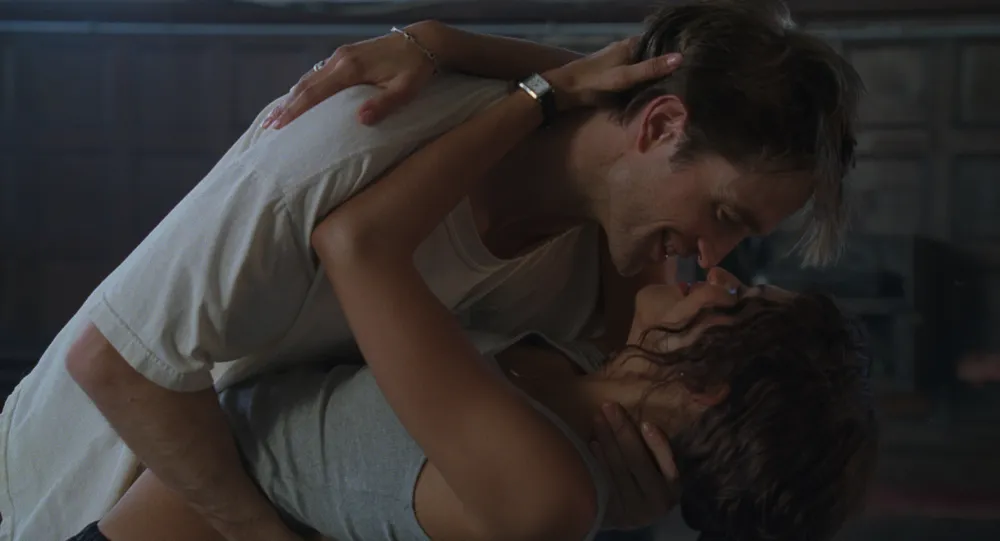
While Katheryn Bigelow made history as the first woman to win the Oscar for Best Director, many tend to forget about The Weight of Water. Told in a non-linear format, this version of Anita Shreve's novel is some parts literary, a 90s' erotic thriller, and some vague idea of European arthouse.
Known as one of the greatest action directors, Bigelow makes a big misstep with this psychological slow-burn. Without a spectacle, the film just kind of, well... does nothing. Following parallel stories in the 19th century and the present, a newspaper photographer researches the actual real-life Smuttynose Island Murders and finds her life paralleling that of the, again, real survivor of the killings.
Neither tale in the film manages to be engaging enough for a whole narrative. It's ambitious for sure, weaving two tales separated by over a century, just ends up being confusing for both the audience and, apparently, all of the actors except for Sarah Polley, who is just really trying to do her best to be an incestuous Norwegian multi-murder witness.
The Keep (1983)
Now, if you were a filmmaker who made a debut like the critically acclaimed Thief, what would you want to do next? If you're Michael Mann, it would be to make a film about Nazis unleashing an ancient supernatural force inside a Romanian stone fortress.
Does any of this make sense? No. Neither does the film. Originally supposed to run at a total of 210 minutes, it was cut down to 120 minutes. That cut received negative reviews, so it was cut down again to a final 96 minutes. What remains is a story of an SS unit that evokes the wrath of a demonic, cyborg-looking creature. After retrieving a Jewish historian, played by a very lost Ian McKellen, and his daughter from a concentration camp to learn more about it, the creature proceeds to kill all of the Nazis before being defeated by a completely random Greek man. A random Greek man who then transforms into a burst of light, which apparently saves the Romanian village.
A prime example of cheap '80s effects and the talents of Tangerine Dream, there is only one question remaining: where was Molasar for the rest of the war? I think the giant Nazi-killing demon would have been a big help.
Sphere (1998)
A bold sci-fi movie about the horrors of, well, a sphere. Although based on a Michael Crichton novel, director Barry Levinson once again teamed up with Dustin Hoffman for this movie about a giant sphere on the ocean floor that makes people live out their worst nightmares.
Crichton's novel takes the form of a deep psychological thriller, with each of the characters delving deeper into their fears, their only hope of survival being the power of science. A novel can take its time to revel in the unknown, letting each of the characters puzzle over deep concepts such as the nature of the human mind. A movie? Not so much. Watching people sit around and explain these concepts isn't as engaging. Meanwhile, Levinson seems really stuck on the whole sphere thing. The biggest threat this large CGI blob poses is apparently making jellyfish attack people.
There's a good middle ground between being entertaining and being all psychological. Can humans bear to understand the vastness of the universe? Their own minds? Seriously, what's up with the sphere? Maybe there is a reason this was Levinson's one and only venture into sci-fi.
Max My Love (1986)
In a world where love is supposed to conquer all, Max My Love asks, "But... what if it conquers a chimpanzee?" That's right. Imagine coming home one day to find your partner cheating on you, not just that, but with a literal primate.
Directed by Nagisa Ōshima, an auteur with a flair for erotic thrillers, this film is instead a comedy. Well, that's what it thinks it should be. It's a completly absurd film that gets played totally straight, about, again, I cannot stress this enough, a woman who falls in love with a chimpanzee. Absurdity involving a very uncomfortable ménage à trois, ape roommates, and a chimp with a shotgun are the natural turn out. Much of the irony of the film comes from the fact that people are just too dignified and polite to point out how utterly absurd this all is.
Just to be clear, Max is not a real chimpanzee. He’s played by a man in a very obviously fake monkey suit. So really, Max, My Love isn’t asking "what if a woman had an affair with a chimp? It’s asking "what if the entire bourgeois moral order could be upended by said adulterous chimp?"
Jade (1995)
Not even William Friedkin was safe from the '90s craze of erotic thrillers. Enter Jade. Also known as the film that ended David Caruso's big-screen career. Weird editing, weirder sex scenes, and a classic Friedkin car chase. All draped in unnecessary amounts of beige. Strange for a movie named after a colour.
Caruso looks permanently confused, and Chazz Palminteri mostly just yells. The plot is a tangled mess of murder, blackmail, and awkward glances that never quite connect. The dialogue swings between stiff and cheesy, with none of the subtlety you’d expect from a thriller. Cops who need some serious ethics investigations, killer wives, and questionable investigative work, the film tries its best to jump on the Basic Instinct bandwagon, but can't grab on.
Then there’s the car chase. Classic Friedkin: fast, loud, and actually thrilling. It’s the one time the film remembers it’s supposed to be a thriller, tearing through the streets of San Francisco before it abruptly returns to the soft-focus haze of awkward sex scenes, and courtroom drama that feels like it’s trying really hard to be mysterious but mostly just feels tired.
Ghosts of Mars (2001)
Yes, not Vampires, Village of the Damned, Prince of Darkness, or even Escape from L.A., but Ghosts of Mars is taking the title of John Carpenter's lowest moment.
Starring acting heavyweight Ice Cube, the film is about, well, ghosts. On Mars, of all places. Beginning life as a Snake Plisskin sequel in space, it mutated into a chaotic blend of sci-fi, horror, and leather-clad spirits, told with plenty of flashbacks, flashbacks in those flashbacks, and a few more for good measure. We learn how a colony of miners become possessed by the ghosts of ancient Martian warriors.
But it’s not just the confusing storytelling that trips it up. The world-building feels half-baked—Mars is supposed to be this gritty, dangerous place, but the sets and effects come off cheap and uninspired. The characters are mostly forgettable, stuck in clichés that even Carpenter’s direction can’t salvage. The soundtrack tries to punch up the mood but ends up feeling mismatched and distracting. Overall, Ghosts of Mars feels like a film where the cool ideas never quite land, leaving you with a messy, forgettable ride that’s more frustrating than fun.
North (1994)
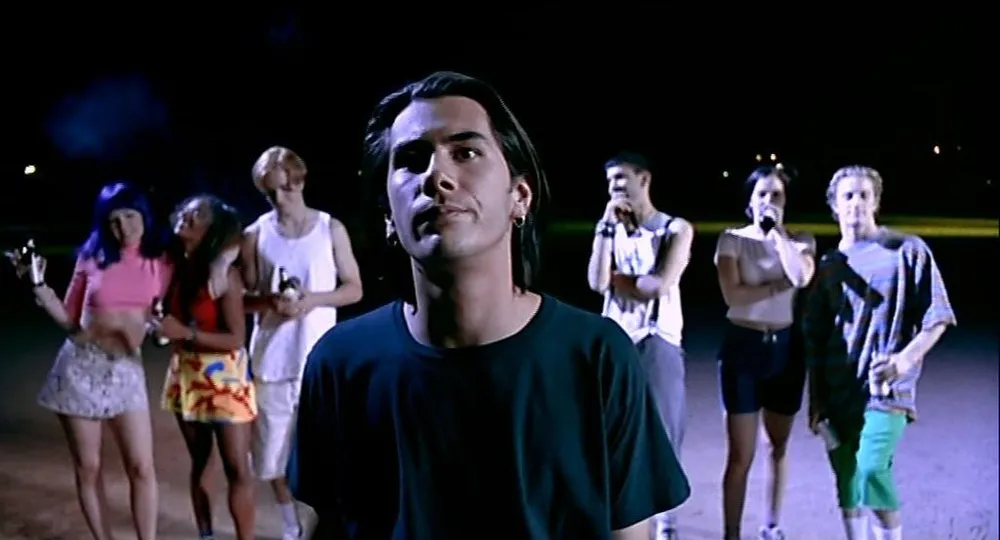
As Roger Ebert famously said of this film: "I hated this movie. Hated hated hated hated hated this movie. Hated it. Hated every simpering stupid vacant audience-insulting moment of it. Hated the sensibility that thought anyone would like it. Hated the implied insult to the audience by its belief that anyone would be entertained by it."
So, not Rob Reiner's best. The film stars an adolescent Elijah Wood as a young boy who decides to "divorce" his parents, who just so happen to be George Costanza and Elaine Benes. He travels the world in an adventure that is part musical, part racists, part child-assassination plot, and apparently all a dream. Not unlike Donnie Darko, giant bunny included.
In the end, North feels like a collection of badly thought-out SNL sketches. It's lived on in the reputation of one of the worst films ever made. That it was directed by the same man who gave us The Princess Bride feels like the equivalent of finding out this was Scarlett Johansson's first ever film appearance. Strange, disappointing, and just a little bit heartbreaking.
Jack (1996)
So, what to say about Jack? Should I start with the concept of a mid-forties Robin Williams playing a ten-year-old boy? That this film came out a few years after Francis Ford Coppola filed for bankruptcy for the third time? That it stars Bill Cosby?
Whatever it is, one thing is for sure; Jack is not just a strange movie, it’s a weird moment in cultural history. It exists in that odd mid-90s space where Hollywood was throwing money at heartstring-pulling high-concept comedies and hoping that some mix of star power and sentimentality would result in magic. There's an unsettling tonal whiplash throughout; one minute it's playground antics, the next it’s an emotional monologue about mortality. And through it all, Coppola directs like he’s still trying to make The Godfather.
Still, it’s hard to look away. Jack is like a time capsule of misfires: an award-winning director out of his element, a beloved comedian grappling with his own dualities. It wants so badly to be profound, to say something about growing up too fast and the fragility of life. But instead, it ends up saying more about Hollywood’s willingness to green-light anything if there’s enough star power and Bryan Adams. And yet, somehow, beneath the chaos and confusion, there's a kernel of sincerity. Despite everything, Coppola continues to defend his film, maybe a glimpse into the kind of movie a ten-year-old boy would certainly make.
So what do we learn from this catalogue of cinematic missteps? Maybe, that genius isn’t a constant state; it flickers, it wavers, and sometimes it disappears entirely for the length of a feature film. Maybe that even the most celebrated filmmakers are still just people, prone to bad instincts, financial pressure, or the occasional midlife crisis. Or maybe it just proves that the line between a masterpiece and a disaster is thinner than we’d like to admit, and often, only hindsight can tell the difference.