Table of Contents
With the release of the third film in the Knives Out series, we've seen an uptick in interest in the murder mystery genre. Chris Columbus's most recent film The Thursday Murder Club follows this trend. Released to Netflix in August of 2025, the film follows a group of senior citizens who solve murders while trying to stop their retirement village from shutting down. This premise helps the film stand out in a genre that is starting to become a little over-saturated.
I found The Thursday Murder Club entertaining, but I couldn't help but feel a little disappointed in the end. While the film is a fun take on a whodunnit, it lacks a lot of characteristics which are staples of the murder mystery genre.
Embed from Getty ImagesIf you asked me what my favorite aspect of this film was, I would tell you that I loved its fun characters. The four senior sleuths, Elizabeth (Helen Mirren) the ex-M16 officer, Ron (Pierce Brosnan) the retired union leader, Ibrahim (Ben Kingsley) the former psychiatrist, and Joyce (Celia Imrie) the retired trauma nurse, are the glue that holds this film together. Their antics and relationship to one another invests the audience in their problems.
In fact, I wish that the film had focused more on the group's friendship. When Joyce is first introduced to the group, most of the members get along with her, except for Elizabeth who is mistrusting and rude to her throughout the film. Considering that former member of the group, Penny (Susan Kirby), was hospice during the film, I assumed that this was a set up for Elizabeth and Joyce to become close throughout the film and that Elizabeth's arc would be to open herself up to new friends. I was halfway right in that Elizabeth is eventually the one to admit Joyce to the club, but Elizabeth never really stops being rude to Joyce. This makes the conclusion of this plot feel abrupt.
Instead, the film's subplot focuses on two police officers who are solving the same murder as the club. These characters are much less entertaining and likeable.
On the same note, the film struggles to set up its reveals. At the start of the film, the club is working on solving a cold case that Penny was hiding from them. Towards the end of the film, it is revealed that Penny killed the perpetrator of this cold case. While the club finds a few clues during the course of the film, they don't find enough evidence to come to this conclusion, which means that the characters have to verbally explain why they think Penny did it.
The evidence also doesn't feel like it would hold up in court. When looking at an old picture of Penny working on the case, Elizabeth concludes that the look in Penny's eyes is enough to prove that she's a murderer.
Embed from Getty ImagesMy biggest problem with this film was the dialogue. It is by no means bad, in fact, most of it is very funny. However, much of the dialogue lacks subtext.
Robert McKee's book Dialogue defines subtext as "the meanings and feelings that flow below the surface." Take this moment from another whodunnit, Who Framed Roger Rabbit:
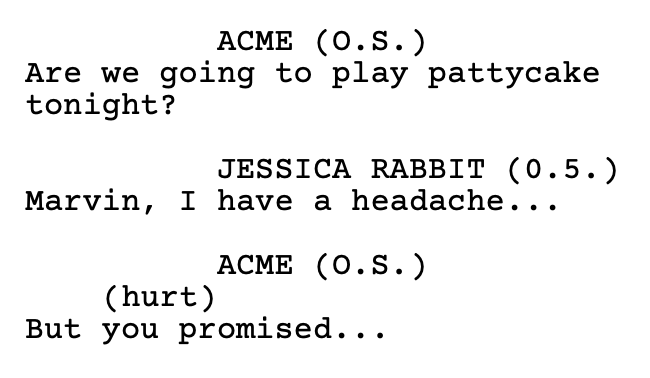
When Jessica says she has a headache, she's telling Acme that she doesn't want to play pattycake without saying it literally. This piece of dialogue is also a clever joke; it tricks the audience into thinking that Acme is referring to sex, when he really does mean pattycake. Using subtext makes dialogue less bland and more realistic. When we speak, we generally don't tell people everything that we are thinking or feeling. This is because we either don't want to or we are unable to exactly articulate everything that goes on in our minds.
There are several moments in The Thursday Murder Club where characters seem to say exactly what's on their mind. For example, towards the beginning of the film, Joyce stares longingly at a photo of her late husband and says "I do hope I'm right about this, Gerry. I'm not used to making big decisions on my own". It's not unrealistic for someone to talk to a photo, but the information that this dialogue gives us feels too much like exposition. The fact that Joyce worries about her decision making skills could have been shown through her actions rather than told, especially since this isn't a characteristic that Joyce seems to display otherwise.
Another problem caused by the lack of subtext is that very few of the characters in the movie lie. We don't often think about this, but lying is an important aspect of the murder mystery genre. Lies act as an obstacle for the detective to overcome. Without them, the mystery feels like it is solved too easily. The lack of lies also makes the dialogue feel unrealistic. It's unlikely that a person who committed a crime would automatically admit to it just because they were asked.
While The Thursday Murder Club is certainly worth seeing if you're interested, I think it could have used another rewrite before it hit the big screen.