Table of Contents
I have never been the type of writer who can write by the seat of my pants.
I’m envious of those screenwriters who can. Those who can start a script from the opening image and venture their way through each and every act without a compass or a map. Just their wit and a sense of where the story is going. How adventurous!
For me, trying to write a script without a plan feels like something closer to dread. Like a sailor in a rowboat lost at sea with a storm approaching on the horizon.
Sound familiar? If you’re like me, then having a plan, and investing some time before you type “FADE IN:”, will help ensure that when you're knee-deep in plot, you don’t get stuck and panic.
And while there are exceptions to every rule, I believe that having a foundational understanding of your story first and foremost allows you the freedom to explore different narrative avenues down the line.
Which is why I find that typing out a beat sheet before I start writing my actual script helps ensure I get my story to the finish line.
But what is a beat sheet? Simply put, it’s a chronological list of all the moments in your story that drive the plot forward. These are the events in your script that need to happen to get your story from its opening image and inciting incident all the way to its climax and resolution.
Not to be confused with your outline, which deals more with your story’s themes and character arcs. Your beat sheet is a bit more clinical; it’s really only interested in your story’s mechanics.
Think of it like the PEMDAS of your script, the order of operations of how your story will unfold.
A beat sheet can also be as detailed or as stripped down as you want it to be. Not sure where to start? Fortunately for both of us, much more insightful writers than myself have offered up their own versions of a beat sheet that we can apply to our own stories.
Let’s start by breaking down one of the most popular beat sheets in the screenwriting world.
Before you type FADE IN, get the format right.
Learn the screenplay formatting rules every writer should know, from sluglines and dialogue to the O.S./V.O. distinction.
Blake Snyder’s Beat Sheet from Save the Cat
Blake Snyder’s approach to the beat sheet from his influential book on screenwriting, Save the Cat, attempts to break down the traditional three-act structure into 15 bite-sized pieces.
- Opening Image (1): Establish your world and story’s tone.
- Theme Stated (5): The message you want to deliver in your film.
- Set-Up (1-10): Present your main character's world as it is, and introduce the fatal flaw or problem.
- Catalyst (12): A moment where everything changes and your protagonist is presented the opportunity to go on a journey.
- Debate (12-25): Your protagonist has to make a choice.
- Break into Two (25): Act II begins as your protagonist makes the choice to go on their journey.
- B Story (30): A moment for your subplot that contains your story's themes. Oftentimes, this is the "love story" within the narrative but that's not a requirement.
- Fun and Games (30-55): What is promised to the audience by choosing to go on the adventure. This is Poh learning Kung fu in Kung fu Panda or Ryan Reynolds and Sandra Bullock pretending to be engaged in Ryan's hometown in The Proposal.
- Midpoint (55): Exactly what it sounds like – the middle of your story. Here's where you want to raise the stakes for your protagonist and introduce some consequences.
- Bad Guys Close In (55-75): Your protagonist's big obstacle, whether internal or external, starts to become a real big problem.
- All Is Lost (75): This is your protagonist's rock bottom.
- Dark Night of the Soul (75-85): An opportunity for your protagonist to mourn whatever was lost. Your character should be worse off here than they were at the start of the story.
- The Break Into Three (85): The moment of realization for your protagonist. The opportunity to not only fix the problems introduced in act II, but also address their own flaws and change for the better.
- Finale (85-110): The opportunity for your protagonist to prove themselves after being "transformed". Antagonists are destroyed and loved ones are saved thanks to your hero.
- Final Image (110): Your final image should mirror your opening image in some way. A reflection of where they started, and how far they've come.
This beat sheet can be incredibly helpful for beginner screenwriters who might appreciate some suggestions on what kind of events should happen and at what point in their script.
For a fun writing exercise, take your favorite film and match its story's beats to this sheet. Not only will it help you conceptualize the role of beats in film, but it will also reveal where other writers deviated from the structure and why.
For something a little less rigid and rooted more in historical literature and mythology, we can turn to Joseph Campbell.
Joseph Campbell's "The Hero's Journey" from The Hero with a Thousand Faces
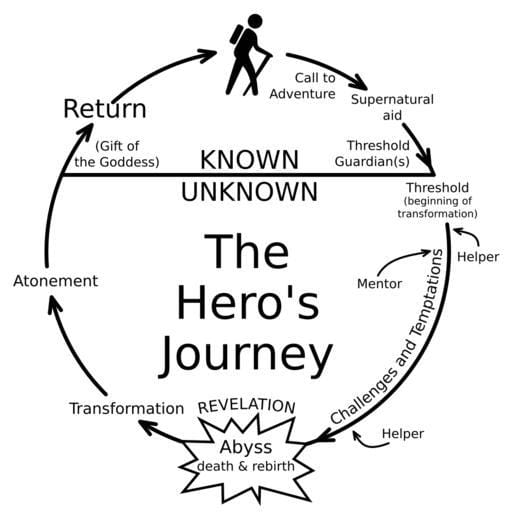
These beat sheets and templates can feel a little formulaic or "script-by-numbers", but are an excellent tool for beginner screenwriters looking to plot and finish their first few scripts.
It's also important to understand the unwritten and ungoverned "rules" of screenwriting as a beginner to know when and how you can break them.
The beats outlined above don't have to happen in your script. Script police won't be knocking down your door just because your opening and closing images don't mirror one another.
But potential producers, executives, and agents, when reading your script, want to know they are doing business with someone who understands the medium and has done their due diligence.
So whether or not you're like me and find yourself stuck in the story of your own creation, or just want to better understand the structure of successful scripts, following these example beat sheets can help you navigate your way to the finish line.