Table of Contents
Certified Copy debuted fifteen years ago at Cannes, marking the first feature film by Iranian director Abbas Kiarostami made entirely outside of his home country.
From his educational shorts for the Institute for the Intellectual Development of Children and Young Adults, to internationally acclaimed features like the Koker Trilogy, Close-Up, and Taste of Cherry, Kiarostami was known for philosophical and minimalist films that blended reality and fiction and explored the relationships that we hold with art, love, and one another.
Although Certified Copy leaves behind familiar landscapes in Koker and Tehran for Tuscany, and stars non-Iranian actress Juliette Binoche and baritone William Shimell, the film nonetheless retains many of Kiarostami's stylistic and thematic hallmarks.
“I don’t think that shooting in Italy changed anything about my artistic style," said Kiarostami of the film. "[...] Even if the place and the language were different for me, the film and its characters were familiar.”
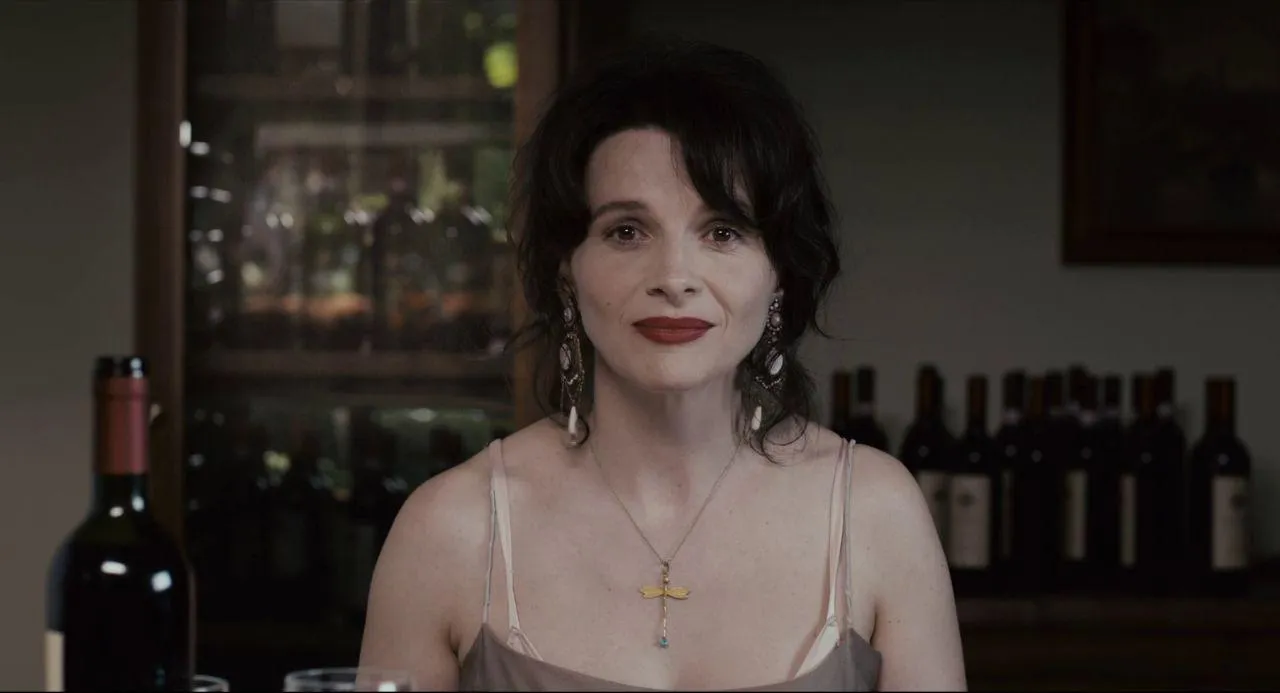
In Certified Copy, an unnamed French antiques dealer (Juliette Binoche) meets an English author named James (William Shimell) at a talk the latter is giving on his book, also titled Certified Copy. Through his writing, James argues that art reproductions are just as valuable as originals, and that originals are in some sense copies too. These themes bleed into the film's narrative as he and Binoche's character tour Tuscany together before James must leave at the end of the day.
An intense awkwardness initially hangs over the two, largely due to the antiques dealer's implied attraction to James. But after a woman at a café mistakes them for a married couple, the two fall naturally into what Kiarostami calls a "game," acting as husband and wife for the rest of the day. As they come across weddings, public squares, restaurants, and hotels, they begin to construct a complex, imagined past of fifteen years worth of marriage—and conflicts.
What results is a heartbreaking and frustrating story about two people who we know have only just met, but feel have known each other for much longer. Although the script impressively handles this complex game of pretend, visual storytelling also plays a critical role in the film’s success.
Let's break down how Certified Copy uses visual motifs of mirrors, windows, and reflections to elaborate on its themes of love and illusions.
Mirrors and Harsh Realities
Two shots of mirrors mark pivotal moments for Binoche and Shimell's characters.
The first happens at a restaurant, when the antiques dealer goes to the washroom to put on lipstick and earrings as the wine arrives at the table in hopes of impressing James. At this point, James and the antiques dealer's imagined marriage has been established, and they have bickered about things like James' book and philosophy of art.
In this close-up shot, Binoche's character puts on lipstick, her expression brightening when she hears accordion music and lively commotion coming from a wedding reception outside. What she doesn't know in this moment of hope is that she is about to walk into an explosive argument with James, which begins because of the restaurant’s bad wine, but quickly devolves into the two hashing out fifteen years’ worth of resentments in their imagined marriage.

This moment is paralleled in the film's final shot, when James enters a hotel bathroom after telling the antiques dealer he must leave to catch his train. The antiques dealer has brought them to this hotel to reminisce about their imagined honeymoon, but James doesn't (or can't) follow along. Just when she is hopeful that they might finally make up, James gut-wrenchingly breaks the illusion they have worked all day to create.
All of Binoche's hope from the first mirror shot is gone. Shimell's character stares at his shadowy reflection with a harrowed expression. Whereas the antiques dealer was hit by he harsh reality after her mirror shot, James is experiencing it now, as the effects of experiencing fifteen years of a failed marriage in a single day finally take its toll on him.

Windows Into Happier Worlds
If Certified Copy's mirrors provide us a look into unhappy realities, then its windows do the opposite.
Throughout the film, we often see windows framing images of marital bliss. One notable scene occurs during the aforementioned restaurant argument. The camera shows a medium point-of-view shot of James sitting in front of a window showing us the wedding reception outside. We, through the eyes of Binoche's character, can see the blurred shapes of wedding guests mingling and dancing.

The antiques dealer is momentarily distracted from James' grey suit and bitter expression as she looks upon the warmly-lit wedding wistfully. She seems to be revisiting a love that is long gone from her life, or was never there to begin with.
Here, the window becomes a view into a happy world that is just out of reach. This inaccessibility is further highlighted when the newlywed couple approaches the window to invite Binoche's character to join them, but they cannot hear each other through the glass.

In the hotel scene, memory is the barrier that prevents James from accessing the happiness he supposedly experienced on his honeymoon. Although the antiques dealer repeatedly asks him to try to remember the view from the hotel window, James cannot. Whether this is because the husband-character he is playing has forgotten, or because James has grown tired at conjuring up fake memories from a fictitious marriage, we don't know.
Interestingly, James' profile is reflected, like a mirror, on the glass pane of the open window. Through this reflection, we can see him look around for a few seconds before lowering his head in resignation. Our view into the window's happy world is thus blocked by James through both his body and his reflection, hinting at the unhappy ending that is to come.
Moreover, the final shot of the film gains new meaning as we see that James is not only reacting to his own reflection, but also to the window behind him, and all of the happiness within its world that he knows is gone for good.

Other People as Windows and Reflections
There's one more visual motif that Certified Copy uses to expand upon its themes: images of other couples.
James and the antiques dealer encounter an older couple when they are debating the artistic merit of a statue in a public square. At first glance, it appears that the husband is scolding the wife as his back blocks our view of her. Then, he turns to his left and we realize he is actually arguing with someone else on the phone—another play between perception and reality. The other couple seems, in fact, to be having a pleasant day out.
As the antiques dealer loops them into their debate about the statue, the husband breaks off to speak with James while the women continue discussing art.
"I'd like to give you a piece of fatherly advice," the older man says, assuming James really is the antiques dealer's husband. "I think all she wants from you is that you walk beside her and lay your hand on her shoulder. That's all she's longing for. [...] All your problems can be solved by a simple gesture. Do it and set yourself free."

Although James first appears dismissive, he later places his hand on the antiques dealer's shoulder as they walk away from the square. This simple gesture proves to be one of their most intimate, loving interactions.
This scene adds a further depth to the mirror and window motifs of the film by giving people a space within the visual metaphor. That is, the other couple is both window and reflection. By hearing the older man's advice and watching the way in which he and his wife interact, we get a window into another (ostensibly happy) world of love, companionship, and understanding. Simultaneously, the couple acts as a foil for James and the antiques dealer, reflecting back to them the failures of their fifteen imagined years together. We can really see the people-as-reflections motif when the men split off from the women and walk before them, creating divisions down the centre and through the middle ground of the shot that emphasize the (a)symmetries between the two couples.
The presence of the other couple is therefore bittersweet. They demonstrate that a happy future is really possible, and not just an illusion created by wistfully looking out windows. Nevertheless, their lives remain just out of reach. After their conversation at the square, they do not meet the older couple again.
Showing What We Can't Tell
It's clear that we often can't elucidate the emotions that we experience—especially the ones that matter the most. In a way, this is the heart of the conflict between James and the antiques dealer: they simply do not understand one another.
Kiarostami seems to have a slightly different view on misunderstanding, however. "Love is the result of misunderstanding," he said in a 2012 interview with Criterion. "When we don't understand someone, we fall in love with them. When we realize that individual's truth, we say they weren't who we thought. So love is nothing but an illusion."
But Kiarostami finds value in the illusion and believes that the original (if it exists) is out of reach for most of us. "Fortunately we have this capacity," he goes on. "Otherwise, there would only be one original, and everyone would fall in love with him or her."
Certified Copy's central themes of copies and the relationships men and women form through marriage are highly complex, but they maintain emotional depth through Kiarostami's extensive use of mirrors, windows, and reflections to tell us things that might not be otherwise communicable. Although the film features a small cast and its narrative takes place over the course of only a day, the worlds and lives of James and the antiques dealer feel deeply and painfully real. In a story centred around illusions, ambiguities, and communication breakdowns, it is no wonder that visual motifs come to supplement (at at times, replace) dialogue in showing us how love starts and where it ends.