Table of Contents
Fifty years ago, Talking Heads made their live debut at CBGB's in New York City. Two years later, they released their debut album, Talking Heads: 77, featuring their smash hit "Psycho Killer." Now, to commemorate five decades worth of iconic art rock songs, eclectic music videos, and an acclaimed concert film, the band has finally released a visual counterpart for "Psycho Killer."
However, "Psycho Killer" looks quite different than the band's other music videos from the 80's, like "Once in a Lifetime." With members David Byrne, Tina Weymouth, Chris Frantz, and Jerry Harrison absent from the video, we instead find actress Saoirse Ronan performing the wacky dance moves normally expected from Byrne. With director Mike Mills at the helm, "Psycho Killer" takes a new artistic approach to the medium. By comparing the similarities and differences between "Once in a Lifetime" and "Psycho Killer," we can learn a lot about the music video as an art form and all of the creative possibilities it has to offer.
"Psycho Killer" and the Violence of Normalcy
When constructing his visual interpretation of "Psycho Killer," Mike Mills, whose film works include 20th Century Women and C'mon C'mon, intentionally avoided being simple and straightforward.
"The song is so much more than being psychotic or killing," Mills explained in an interview with Vulture. Talking Heads themselves concurred, saying in their statement on the music video, “We LOVE what this video is NOT—it’s not literal, creepy, bloody, physically violent or obvious."
The official music video for "Psycho Killer." Video: YouTube.
In the music video, Saoirse Ronan plays a woman going through the everyday cycle of waking up, brushing her teeth, going to work, driving home, and going to bed. Bookended by time lapses of the sun and moon rising, Ronan's days vary only slightly—she wears different clothes, talks to different coworkers, fights and makes up with her boyfriend, and occasionally sees a therapist.
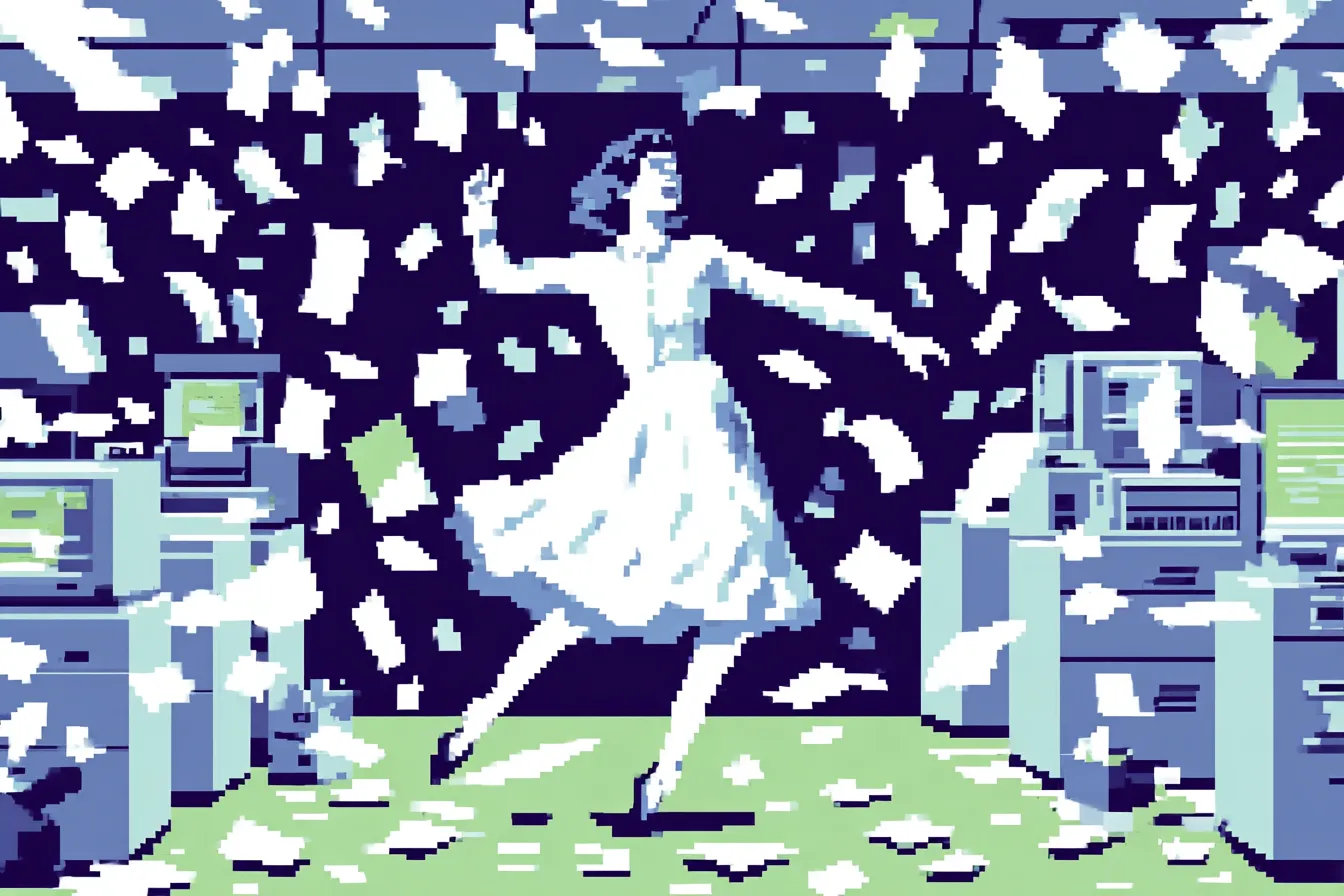
What really distinguishes these otherwise banal cycles is the emotional rollercoaster she experiences over the course of the four-and-a-half minute-long video. Worn down by the monotony and isolation of her life, Ronan grows tired, bored, angry, paranoid, and miserable as she begins to spin, run around, and throw various objects. She also begins to dance, slowly bringing her hands up to her face. Then, her whole body engages in a frenzied dance through all of the now-familiar milieus in her life. Finally, Ronan slows down, calmly closing her eyes and reaching her arms out in fluid motions, as if feeling the contours of invisible shapes around her.
Ronan's isolation is emphasized by the fact that the people around her seem not to notice (or care) about her emotional breakdown. Shots often feature Ronan alone or amongst people who are turned away from the camera, or walking by too briskly to get a good look at their faces. The cold, grey drabness of the office (which was shot in an old hospital compound) lends her workplace a clinical, impersonal feel that is mirrored in the therapist's office, as well as in many of the domestic scenes.
"There's something violent in the banality of it all," said Mills in the same interview. "It’s psychic violence, but it’s still hostile to me. I don’t think normality actually exists. It’s a construct.”
Rather than showing us the kinds of violence Ronan could inflict on her boyfriend, therapist, and coworkers through a spree of psychotic killings, Mills' "Psycho Killer" instead shows us the violence that she endures. Violence that occurs at the hands of capitalism, boredom, neglect, individualism, and self-criticism– things that we encounter far more often in our daily lives than serial killers.
"Once in a Lifetime" and the MTV Era
Through its themes of alienation, isolation, and cyclical repetition, Mills' music video draws some similarities to another Talking Heads hit, "Once in a Lifetime." Particularly, the plain, monotonous setup of Ronan's life draws parallels to the end of the song's opening verse:
And you may find yourself
Behind the wheel of a large automobile
And you may find yourself in a beautiful house
With a beautiful wife
And you may ask yourself
"Well ... how did I get here?"
As the lyrics to "Once in a Lifetime" put it, Ronan lets the days go by, and her life and the people around her remain the "same as it ever was" while she experiences her emotional breakdown.
Unlike "Psycho Killer," however, "Once in a Lifetime" did receive an official music video shortly after its initial release in the 1980 album Remain in Light.
The official music video for "Once in a Lifetime." Video: YouTube.
Co-directed by Toni Basil and David Byrne, the "Once in a Lifetime" music video looks and feels practically nothing like "Psycho Killer." Shot on a low budget with a blue screen, "Once in a Lifetime" features a multiplicity of sweaty David Byrnes swimming through blue-green static and dancing erratically in white voids. Byrne, outlined by chromatic aberrations that further lend to the video's low-budget feel, delivers lip-synced lyrics as an impassioned sermon while images of religious ceremonies appear in the background behind him.
Soon after its August 1981 launch, MTV quickly latched onto this music video and incorporated it heavily in its rotation, allowing for fans to view Byrne's iconic performance on repeat.
What Does Talking Heads Teach Us About Music Videos?
In comparing "Psycho Killer" to "Once in a Lifetime," we can see how the music video, as an art form and a medium, allows artists to stir up feelings and rhythms, as well as offer powerful statements and narratives. Though they may seem to have little in common at first glance, both music videos skillfully attempt to enhance their respective songs in a manner cohesive with the band's larger artistic image.
- Working Around Budget in Telling Stories
The low-budget, solo performance of "Once in a Lifetime" may seem to stand in stark contrast with "Psycho Killer," yet both music videos work within their limitations to produce interesting visual accompaniments to their music.
For instance, the use of a blue screen, rather than elaborate sets, in "Once in a Lifetime" allows for Byrne's physical presence to seem disjointed from both time and space, similar to how the song describes flowing unconsciously through life. The constant zooming in and out of the camera further disorients us, while the archival images that appear behind Byrne create visual parallels between his jerky dance moves and ceremonial rituals from around the world.
Meanwhile, "Psycho Killer" is able to afford shooting on multiple locations with higher quality equipment, as well as casting Saoirse Ronan and several other actors. As a result, Ronan is able to physically interact with and orient herself in relation to various props, sets, and people that share the space with her. This drives forward the music video's sense of mundane familiarity and emotional isolation.
- Star Image and Bodily Performance
The way the star personas of Saoirse Ronan and David Byrne interact with the music and visuals are also worth comparing. Ronan, who starred in such films as Lady Bird and Little Women, continues to play an acting role in "Psycho Killer" one that is punctuated by dance. On the other hand, Byrne is a musician and performer, continuing these roles as he lip syncs and dances while looking into the camera. He is also acting, in a sense, when he behaves like a fervent preacher in the music video, but he does not appear to go through a character arc in the way that Ronan does.
These two performances offer another insight into the different ways in which music videos can operate. The use of direct address, the construction of characters, and the presence of stars who set up certain expectations about the nature of their performance, all serve to produce different effects in the viewer and bring new meaning to the music.
- Where We Find Music Videos: From MTV to YouTube
The platforms on which we discover and access music videos also play an important role in our experiences of the medium. "Psycho Killer," whose song's initial release predates the MTV era, is now available publicly on YouTube, as is "Once in a Lifetime."
The music video is perhaps now more accessible than ever—but so are many other audiovisual mediums. Rather than being placed into a rotation of music videos on one, curated TV channel, both music videos now live in algorithms amongst vlogs, news clips, viral videos, other music videos, and more. ("Psycho Killer" was also made available for streaming on the Criterion Channel, which calls attention to the similarities it shares, in narrative and appearance, with short films.)
Comment sections are also now ubiquitous, allowing for public forums in which people share their opinions on music videos, offer interpretations, make jokes, share anecdotes, and so on. The experience of watching a music video is now often coupled with the experience of knowing what other people think about it. Creators of music videos can play with the new possibilities afforded by online spaces and algorithms to both reach new audiences and foster communities in existing fanbases.
The Possibilities of the Music Video
Although Talking Heads has long since disbanded, the new release of "Psycho Killer" has revitalized the band's impressive body of music video works and offers us key insights into the evolving history of music video production and distribution. Dizzyingly and unforgettably eccentric, "Once in a Lifetime" and "Psycho Killer" show us an enormous versatility to the medium. Certainly, by looking at other music videos by Talking Heads and beyond, we can begin to see just how expansive the possibilities are for creating our own music videos too.