Table of Contents
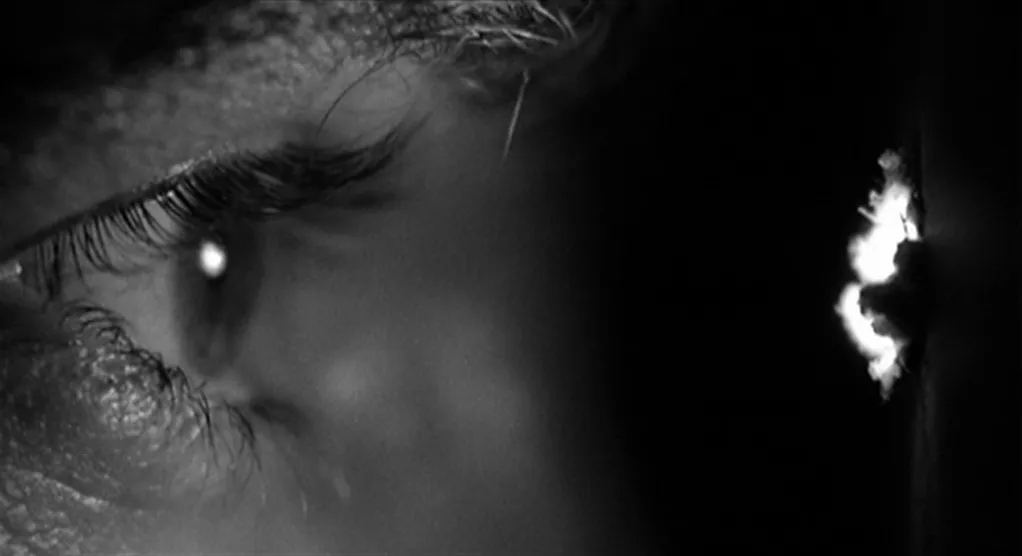
The close-up is often described as a camera angle used to frame a face and capture detail. In practice, it is far more complex than that. The close-up does not simply show us what a character looks like. The technique tells us how to feel, where to focus, and when something matters. From the emotional functions to film theory, this article will take a close-up on the close-up.
Brief History
One of the earliest uses of the close-up appears in As Seen Through a Telescope (1900), directed by George Albert Smith, where the shot introduced audiences to a new visual perspective altogether. Early experiments continued in The Big Swallow by James Williamson and later in The Lonedale Operator by D.W. Griffith, helping establish the close-up as a storytelling device rather than a novelty.
By the time Carl Theodor Dreyer released The Passion of Joan of Arc, the close-up had evolved into something transformative. Dreyer’s framing of Joan’s face opened cinema into a world of raw emotion, proving that a close-up could carry an entire film’s psychological weight.
From there, the technique became more widely used across cinema. The close-up began to have iconic moments in film history. The dramatic tension in The Good, the Bad and the Ugly, the establishing of power in The Godfather, and the terror amplified in Psycho. There are endless amounts of films that wouldn't have the emotional, spectatorial, or even psychological impact that they have had without the use of the close-up. The close-up is more than just a shot, it’s a vital element in the art of storytelling.
Intimacy
When the camera moves closer to a subject, something shifts. A close-up does more than enhance detail – it creates emotional closeness. The spectator is no longer observing from a distance but is placed within intimate range of a face, a gesture, even a reflection of self. The close-up becomes something we are now interpreting with our heart, rather than our mind.
Film theorist Béla Balázs says it most profoundly in Theory of the Film, writing:
“The close-up may sometimes give the impression of a mere naturalist preoccupation with detail. But good close-ups radiate a tender human attitude in the contemplation of hidden things, a delicate solicitude, a gentle bending over the intimacies of life-in-the-miniature, a warm sensibility. Good close-ups are lyrical; it is the heart, not the eye, that has perceived them.”
Balázs reframes the close-up as something poetic rather than technical. The camera acts as if it’s a portal that is used to reveal.

Vulnerability
That revelation often comes through vulnerability. The exposing of expressions in a character removes them of protection. In the close-up, there is nowhere to hide. This vulnerability invites the spectator to search deeper than just the face level of the character.
As Mary Ann Doane writes in her discussion of The Passion of Joan of Arc as written in The Close-Up: Scale and Detail in the Cinema (2003):
“Dreyer's Joan of Arc, a chain of close-ups that seem to constitute the very revelation of the soul, is the epitome of the genre. It is barely possible to see a close-up of a face without asking: what is he/she thinking, feeling, suffering? What is happening beyond what I can see?”
Here, the close-up becomes a site of interpretation. It does not provide answers but provokes questions.
Shock
While Béla Balázs sees the close-up as lyrical, Sergei Eisenstein understood it as collision. For Eisenstein, the close-up was not simply intimate but a form of shock. In Soviet montage traditions, a close-up inserted abruptly into a sequence disrupts the viewer’s stream of consciousness, jolting the audience into an immediate emotional response.

Threat
But shock is not its only aggressive quality. The close-up can also threaten.
An extreme close-up can feel less like intimacy and more like intrusion. The spectator may want to step back, to reestablish distance. In horror cinema especially, distorted or fragmented faces magnified beyond comfort transform the human image into something unstable and unsettling.
Rudolf Arnheim warns of this potential:
“The close-up shows a human head, but one cannot tell where the man is, to whom it belongs, whether he is indoors or outdoors… A superabundance of close-ups very easily leads to the spectators having a tiresome sense of uncertainty and dislocation.” (Arnheim, 1957, p. 82)
Arnheim identifies that when isolating the face from space, the shot can produce uncertainty and spatial disorientation.
Theory
Knowing that close-ups can create different emotions for us is one thing, but knowing the psychology behind the close-up is a much deeper understanding. From Walter Benjamin's ‘The Work of Art in the Age of Mechanical Reproduction’ (1936), Benjamin explains his idea based on the optical unconscious. This theory revolves around the idea of the camera revealing what the human eye cannot see. The use of slow motion or magnification makes us aware of things we were not yet aware of.
“With the close-up, space expands; with slow motion, movement is extended. The enlargements of a snapshot does not simply render more precise what in any case was visible, though unclear: it reveals in them entirely new structural formations of the subject.”

Béla Balázs also believed that the close-up reveals what the human eye cannot see, but on a soulful level. He states in his Theory of the Film (1948),
“The close-up has not only widened our vision of life, it has also deepened it. In the days of the silent film it not only revealed new things, but showed us the meaning of the old.”
He also goes on to say,
“Closeups are often dramatic revelations of what is really happening under the surface of appearances.”
When the camera moves closer, cinema changes. What might seem like a mere shot or simple change in framing is actually much more. The close-up is intimate and valuable, yet it can also be shocking and threatening. It can feel comforting in one scene and deeply disturbing in the next. The close-up does not simply reveal the human face; it offers insight into the soul within.