Table of Contents
Three Key Takeaways
- A deeply personal exploration of Alzheimer’s through the lens of a mother-son relationship, told with inventive narrative structure and symbolic imagery.
- The film’s central metaphor, a cockroach, poignantly reflects themes of vulnerability, survival, and love amid loss.
- Independent filmmaking’s freedom was key to realizing a complex, nonlinear story that challenges genre norms and invites emotional resonance.
Italian filmmaker Marco La Ferrara brings a poignant and intimate story to Nòt Film Fest with his short film La Blatta e la Formica (The Cockroach and the Ant).
Featuring a cast led by Diego Facciotti and Margherita Varricchio, the film navigates Alzheimer’s disease through the shifting perspectives of a mother and her son, weaving past and present with dreamlike imagery.
Directed and edited by Marco, whose background spans directing, VFX, and animation, the film is a testament to personal storytelling fused with technical artistry.

Q&A Interview
What drew you to make this film? Why this story, and why now?
The film is rooted in personal experiences, from my life and my family, but it also arises as a response to the loss of my father. What I wanted to explore is what remains when the gaze of your parents is no longer there to protect you, and you find yourself alone, facing the world and life.
In my story we see a loving mother, always present for her son, who never abandons him. But then we also see her lost in her illness, retreating into her childhood and, in doing so, forgetting her son. This is where my reflection lies: I believe that one of the greatest gifts a parent can give their child is, at a certain point, to let them go. It may seem paradoxical, but it is precisely this that allows the child to finally become an autonomous individual, capable of making their own way in life.
What surprised you most about the filmmaking process this time—creatively or logistically? Was there a moment on set or in post that completely changed how you saw the story?
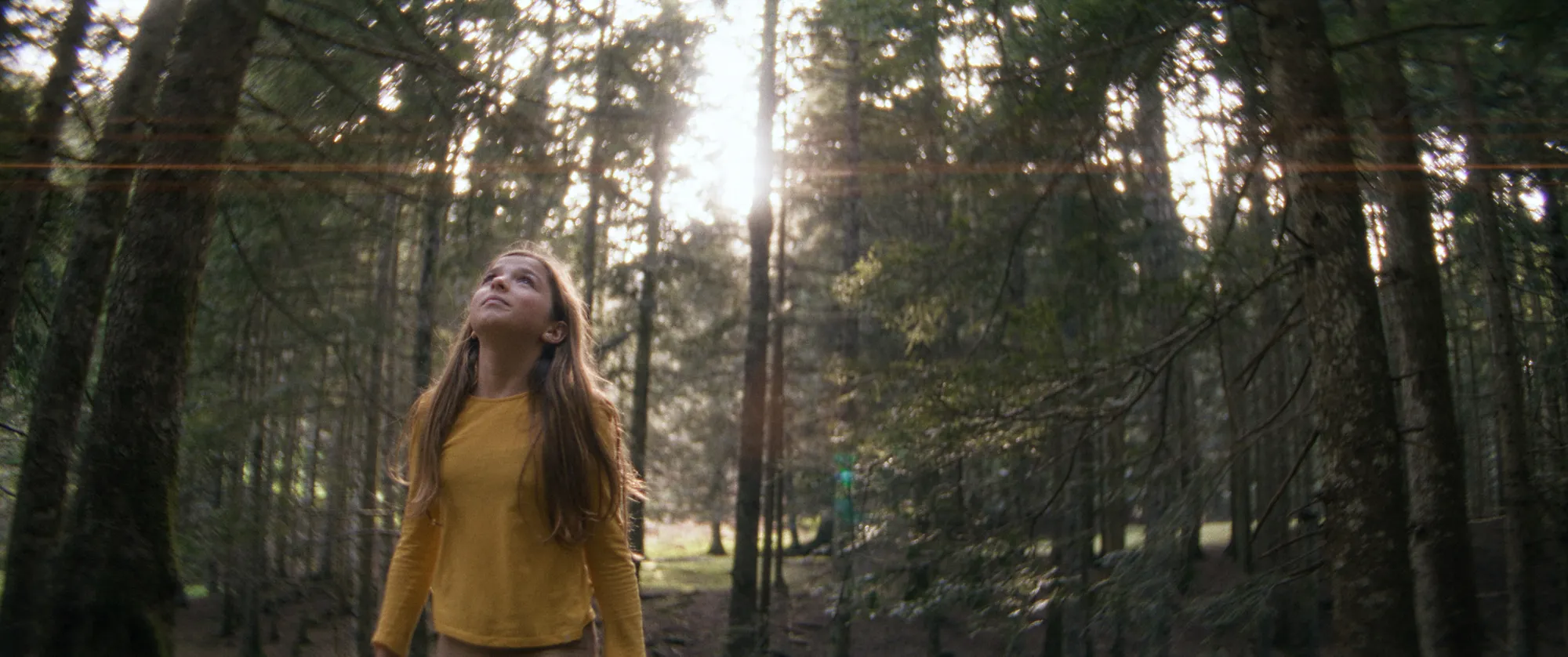
During pre-production, we faced many challenges in finding the right locations to tell this story. The short film features numerous settings, each with a precise narrative role: the father’s house, seen in the daughter’s childhood memories, needed to architecturally mirror the structure of the nursing home where the elderly woman now lives, creating a visual parallel. The forest, on the other hand, had to be an evergreen—an ambivalent place of discovery and disorientation, where the mother-child’s mind generates playful, happy memories, but also a place where she becomes lost and confused.
During production, what pushed me to change my perspective was the interpretation of the actors, who unexpectedly embraced the story with great passion and determination, giving me many opportunities for reflection and dialogue. I especially remember the night shoot of the alley scene: Margherita Varricchio, who plays the mother, struggled to say the line addressed to Davide Di Mezzo (Mino as a teenager): ‘If this is what you want, get out of the car now and I will say goodbye to you.’ For her, it was inconceivable that a parent could ever say such words to a child. But that line came directly from a real-life episode, when my mother said those exact words to my brother. It was in that moment that the actress was able to internalize the pain behind the phrase and understand its true meaning: not abandonment, but an act of love.

Is there a moment in the film that feels the most you—something only you could have made?
One of the scenes that I find most representative is the staircase sequence. Just before, the little girl had drawn the cockroach and promised to “never forget it,” but in the following moment she forgets it completely. With that, I wanted to portray their deepest distance: just as she forgets the cockroach, she also forgets her son. On the staircase, the girl has erased everything—even her own face—and for this reason she wears a mask. She is lost in another world, now incomprehensible to Mino. On the glass window behind her, two birds are drawn flying in opposite directions: a visual symbol of the two of them moving apart, each in a different direction.
The same happens in the ending, when we finally see reality through Mino’s eyes and encounter the elderly mother. When he plays her record, she has a fleeting moment of clarity and remembers her son. But in that sequence, he never turns to look at her: her face remains blurred, her voice off-screen. I chose this precisely to underline the fragile, ephemeral nature of her lucidity: she is fading, and he, though happy, does not find the courage to meet the eyes that had always watched over him as a child. In that instant, the mother asks him to go pick himself up from school, as if to say: “Now you must do what I can no longer do. Take care of yourself.” It’s a way to return to the central theme of the short: what remains of us when our parents are gone. Perhaps this is their last act of love—their absence gives us the chance to truly exist and to become, at last, ourselves.
“One of the greatest gifts a parent can give their child is, at a certain point, to let them go.”
The cockroach is a striking symbol. Can you explain its significance?
Mino is a deeply sensitive person, profoundly connected to nature and its creatures. Since childhood, this sensitivity has made him vulnerable in his relationships with peers: he struggles to fit in, is marginalized, and bullied. The absence of his father—hinted at but not developed—has further contributed to his loneliness. As he grows, these difficulties, combined with anxiety about the future, drive him to seek refuge in substance use.
From here comes the analogy with the cockroach: an insect seen as an intruder to be eliminated, an unwanted and invisible being that survives on the margins—the very image Mino has of himself. The mother, however, even in the depths of her illness, when she believes she has returned to childhood and no longer remembers being a mother, sees in a cockroach something precious, something to be protected and cared for—a metaphor for her son.

What was the hardest creative decision you made while making this film?
The most difficult decision was to center much of the story on my personal experiences and my own life. Perhaps with the slightly arrogant idea of not wanting to make the usual ‘entertainment’ short film, with simple themes and a linear structure typical of the format, but instead to tell something I felt a real urgency to share.
During the writing process, I received a lot of criticism from producers and industry professionals regarding the narrative structure on three levels and the use of flashbacks, which they considered unsuitable for a short film. To me, this structure felt like the most appropriate way to build mystery and anticipation. Even the choice of the insect was not an easy one: many considered it off-putting to include a cockroach, even in the film’s title. But for me, the parallel between the son and the cockroach was essential.
Despite this, I chose to carry on with my vision. My goal was to create a film capable of condensing, in just 15 minutes, the weight and complexity of two lives that intertwine and influence each other, across time and distance created by illness.
What do you hope audiences take away from your film?
The film tells the story of a woman affected by Alzheimer’s who no longer recognizes her son and retreats into her childhood, but also of the growth of a young man who, after a lifetime under the protective gaze of his mother, finds himself for the first time without that support. I wanted to show the difficulty of becoming an adult and how, paradoxically, the distance created by his mother’s illness represents her last act of love for him. Her absence gives him the chance to truly exist as an individual, to stand on his own. In the end, the last gesture of love a parent can offer—even if it may seem paradoxical—is to let their child go, so that they may discover that, even alone, they can endure.

What’s a tool or technique that really helped you during production?
Since I work in post-production and VFX, before committing to this project I carried out several tests and created a 3D animation of the cockroach, to ensure that the final result wouldn’t look artificial or break the atmosphere of the film. I also designed specific shots that allowed the characters to physically interact with the insect, making its presence appear more natural and believable. On the technical side, we used Atlas anamorphic lenses combined with a Red Raptor camera and high-quality diopter filters, which allowed us to capture extremely close close-ups—of both actors’ faces and the insect—while preserving the anamorphic look that gave the frames a sense of openness and prevented the space from feeling claustrophobic.
“The parallel between the son and the cockroach was essential.”
Independent filmmaking is often about rewriting the rules. How did you lean into that on this project?
The true strength of independent cinema lies in the freedom it gives each filmmaker to tell their story without constraints. It is true that in a self-production the means and resources are limited, but precisely for this reason there are fewer external pressures. This allows room for experimentation and for making choices that, from a commercial standpoint, might not be considered ‘correct.’ I believe this phase of experimentation is essential for a young filmmaker: it not only helps define one’s path and personal way of storytelling, but also fosters a solid self-criticism that constantly pushes toward improvement.

What does it mean to you to have your film selected for Nòt Film Fest?
It is a great honor for us to have been selected by the Nòt Film Fest. It is an internationally significant festival, and being part of its official selection brings prestige and value to our work.

Where do you see this film going next?
The future of this film is to take part in as many festivals as possible, in order to showcase it to a wide and diverse audience. Its main purpose is to serve as a true ‘calling card,’ capable of sparking interest and paving the way for the presentation of new projects and feature-length stories that we have already written and developed.
"At the heart of all my work lies a deep desire to tell honest stories. For me, writing and storytelling are ways to try to understand and decipher the world, to feel a little less lost, and to hold on to the illusion of having a few more tools to face life. My hope is that these stories may, even if only in part, offer something similar to those who watch them."

“Independent cinema remains a valuable space of freedom, play, and exploration.”
Cast & Crew
- Vanessa Perticari (Mother – Child)
- Laura Aguzzoni (Elderly Mother)
- Davide Dimezzo (Mino – Teenager)
- Gioele Linari (Mino – Child)
- Sofia Longhini (Nurse)
- Alfonso Porta (Father)
- Director of Photography: Luigi Schiavoni
- Music and Sound Design: Enrico Zavatta
- Production: Lumelab
- Executive Producer: Giulia Camporesi
- Distribution: Siberia Distribution