Table of Contents
One of the best places to look for a story to put on screen is in the pages of a book. Plenty of successful Hollywood films have been made from what were originally novels.
Some stories, however, seem to thrive better in the form of a novel. This could be due to intricate imagery, themes, disjointed narrative, or complex language.
Any adaptation between mediums will prove to be difficult based simply on the fact that they are different methods of storytelling. What may be possible on the page will prove to be difficult if done on film. What makes a story "unfilmable" is due in large part to the aspects that have no direct counterparts on screen, as neither book nor movie has to abide by the same rules.
When it comes to adapting a particularly difficult source material, filmmakers have to make decisions about what parts of the original content to include, alter, or cut in order to properly translate the plot and themes.
While not all book adaptations are successful, there are plenty that manage to balance the most complex parts of the written story on the screen.
Ulysses (1967)
James Joyce's novel is the epitome of an infamously difficult read. Noted for using the modernist approach of stream-of-consciousness writing, wherein a character's thoughts are presented in disjointed prose. The novel is divided into three separate parts with a total of eighteen episodes.
A loose interpretation of Homer's Odyssey, the novel runs upwards of 1,000 pages. Dense not only in page count, but also in allusions to the likes of Shakespeare, Dante, and Greek mythology. Each section of the book employs a unique literary style with complex language, wordplay, and a lack of clear narration. Ulysses has long been an iconic challenge for the adventurous reader.
Turning one of the most infamously challenging novels into a film was a seemingly insurmountable task. Finding a way to not only adapt the sprawling page count but to also fit it into a screen-adaptable narrative. It was in 1967 when American filmmaker Joseph Strick decided to do exactly that. Strick's adaptation of the novel attempted to follow the loose plot of Joyce's novel, encapsulating many of the central moments and lines in the film.
Due to the nature of stream-of-consciousness writing, Strick was forced to make certain amends to the content in order to ensure that the narrative could translate to the screen, resulting in the loss of many of Joyce's more complex themes. The film had been criticized for the lack of faithfulness, admittedly something that is a bit much to ask of a film clocking in at a bit over two hours.
Although the film would end up being a divisive work, the very fact that the film got made is a commendable feat. Ulysses would be nominated for Best Adapted Screenplay at the Oscars the following year.
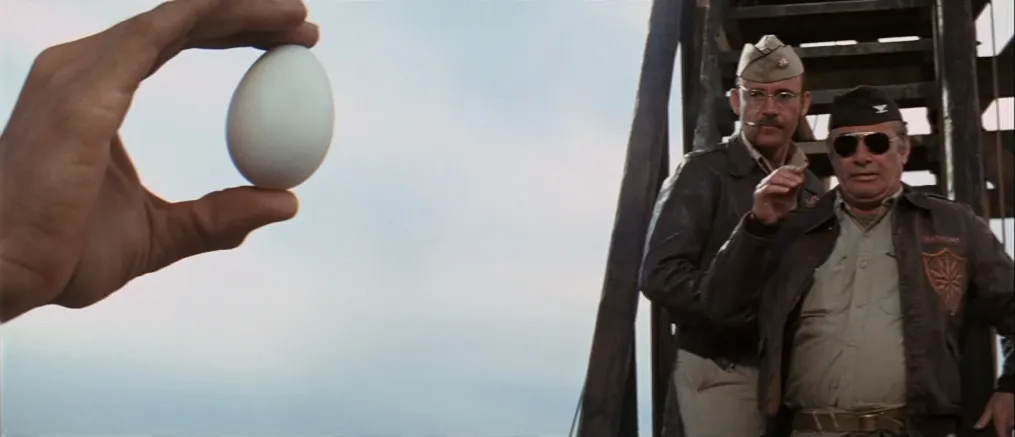
Catch-22 (1970)
The novel Catch-22 by American author Joseph Heller is defined by its style as an absurdist satire, making fun of the military-industrial complex during World War II. The use of non-chronological narrative, with allusions to literary figures the likes of Dostoyevsky and Dickens, all wrapped up in a farce, gave the novel its cult following and status as an iconic piece of literature.
Due to the absurdist nature and disjointed narrative, the narration of Heller's novel is largely unreliable and is directly impacted by the characters and their experiences, occasionally shifting between their perspectives.
Instead of trying to adapt the language of the novel, director Mike Nichols opted to focus more on the thematic nature. Before becoming a successful theatre and film director, Nichols was a comedian.
With an all-star cast of character actors, including the likes of Alan Arkin, Martin Balsam, and Orson Welles, among many others, the comedy of the film adaptation shines through. Although this comes with a tradeoff, meaning that many minor story arcs and lines of dialogue are left out.
The film softened many of the discontinuous events of the novel in order to make it work for the screen. The film still manages to capture the central absurdity by prioritizing the important beats in order to make it adaptable. As such, the film still remains largely faithful to the novel by successfully capturing the spirit and themes of Heller's writing.
Naked Lunch (1991)
The works of William S. Burroughs are not for readers looking for something light. The famed beatnik author had a style that was part absurdist, part explicit, and always written in a dazed prose.
Naked Lunch, being perhaps Burroughs' most well-known title, was written to have no plot. Instead, the novel is composed of a web of loosely connected vignettes in no chronological order.
All of the short pieces within the novel feature nearly everything Burroughs could think of to provoke. Frequent explicit and derogatory language, violence, drug use, sexuality, body horror, and general sadomasochism all within a fluid genre encapsulating horror, science fiction, and parody.
The main question was how to create a film that had no plot and could get away with the content featured in the novel. Yet, in 1991, David Cronenberg released his film adaptation of Naked Lunch.
Instead of remaining faithful to the novel, Cronenberg's version kept only the general connecting themes from the stories. To create a complete narrative, much of the plot was taken from Burroughs' own life, as well as bits from his other novels.
The film has since gone on to become a cult classic, successfully encapsulating what made the original so radical, while reinterpreting its content to tell a new story that puts its author in the spotlight.

A Clockwork Orange (1975)
Now considered a seminal film, Anthony Burgess' novel was once considered unfit for the screen.
The focus on acts of "ultra-violence," including explicit portrayals of physical and sexual violence, alongside the fictional Nasdat slang spoken by the characters, made the novel infamous. Soon after it came out, it began to face legal challenges and bans due to concerns about the content of the story. The explicit nature, use of made-up language, and ongoing attempts at censorship made it a tricky subject to adapt.
Stanley Kubrick had been gifted a copy of the novel, and then set out to make a film based off of it. Largely, the final film remains faithful to the novel, including the depictions of extreme violence carried out by the characters. Kubrick's film makes use of the novel's unique language structure, having narration through the story in Nasdat.
Burgess was cautious about the adaptation, noting that the film had left out the resolving chapter in which the characters are redeemed through good actions. Ultimately, the film would be met with the same treatment as the novel in the form of bans and censorship.
Although the tides have changed on the reception of both the film and novel, now both being seen as classics. A Clockwork Orange was a challenging adaptation not only for the narrative and writing style, but for the frequent legal battles against it.
Dune (1984/2021/2024)
A rare case in which an "unadaptable" work was made into not one, but multiple successful films, is Frank Herbert's Dune novels.
The sprawling space epic was seen as being too large a scale to be translated to film. Not only was the world incredibly complex, but the budget needed to make it come to life would have been too much for studios to take a gamble on.
There were multiple attempts to make a film version of Dune prior to David Lynch's 1984 version. Most directors refused the project due to the sheer size of the world and the time it would take to make it.
Fresh off of a string of Oscar nominations for The Elephant Man, Lynch's film was shot for over 6 months. The project used over 80 different sets, almost 2,000 crew members, and 20,000 extras, and had a budget of over $40 million dollars.
The initial cut of the film came out to a length of over four hours. The theatrical release of the film would be over two hours, with added narration to replace the parts of the plot that did not make it in.
Lynch's film would end up being an infamous flop. The lack of coherent plot points on account of the significant cuts made the scale of the story non-apparent and confusing. Because of the failure to adapt Herbert's novel, it would be close to 40 years before another attempt was made.
In 2021, Dune was once again adapted for the big screen, this time helmed by director Denis Villeneuve. For his turn in bringing the novel to life, Villeneuve decided to turn the over 500-page story into two separate instalments with a combined runtime of 5 hours and 20 minutes.
Taking the time to truly delve into the world of Dune, Villeneuve's attempts have been much better received. Although a lengthy watch, both films take directly from the page to create an adaptation that feels like the novels did.
No Country for Old Men (2007)
While not the first of Cormac McCarthy's novels to get the big screen treatment, Joel and Ethan Coen's version of No Country for Old Men is the most successful.
Not known for easy reads, McCarthy's style of writing includes minimal grammar, no quotation marks, and long passages of descriptive prose.
The novel follows three interconnected stories from the perspective of three different characters. Each chapter opens with a narration delving into the backstory and state of mind of the characters.
No Country for Old Men, unlike the other novels of his that have been adapted, is one of his most accessible. Despite the equal diverging and intersecting points of the three stories taking place, they all end in ways that join together.
For the Coens, the most difficult part of adapting McCarthy's writing is conveying the complex themes under layers of more complex language. While the film would remain largely faithful to the novel, it would only be done by cutting a significant amount of narration and plot details.
While McCarthy's novel takes its time in painting a lush picture of the world around the characters, only saving short sentences for seminal plot points, the Coens use each page to say only what needs to be said.

American Psycho (2000)
The novel that author Bret Easton Ellis himself described as "unfilmable," one of the most praised yet polarizing films of the 2000s was thought to be too controversial for the screen by the writer himself.
American Psycho, the novel, can do what studios can't, which is to depict as much gruesome violence in writing as it wants. This proves to be a significant challenge when turning the book into a film. Restrictions and censorship meant that no mater what, the film adaptation would have to make significant cuts.
A good chunk of the novel is dedicated to internal monologue interspliced between extreme acts of violence, intentionally creating a jarring juxtaposition. With a strongly unreliable narrator and at times delving forward into postmodern satire, the real story can be hard to follow.
Making a film required significant changes to the content and the structure of the story, including cutting down on the violence and translating the unconventional structure and narration.
The film kept the subversive and satirical elements of the novel and added voice-over, mimicking the pages of stream-of-consciousness prose. Unlike the novel, the film could not spend time on the more graphic or ruminating chapters and instead turned more towards exploiting the irony and satire present in the situations of Ellis' original story.