Table of Contents
In A24’s newest horror film Undertone, director Ian Tuason constructs a uniquely unsettling atmosphere through a meticulously crafted sound design and a strong use of negative space. The feature length debut film written by Tuason himself and heavily influenced by his own personal life, offers us a lesson in narrative restraint and how to work with a limited budget. Because, despite a few of it’s weaknesses—most notably dialogue that can feel overly on-the-nose and a lead performance that occasionally comes across as self-consciousness—the film remains a compelling theatrical experience and an entertaining debut from an emerging voice in the horror landscape.
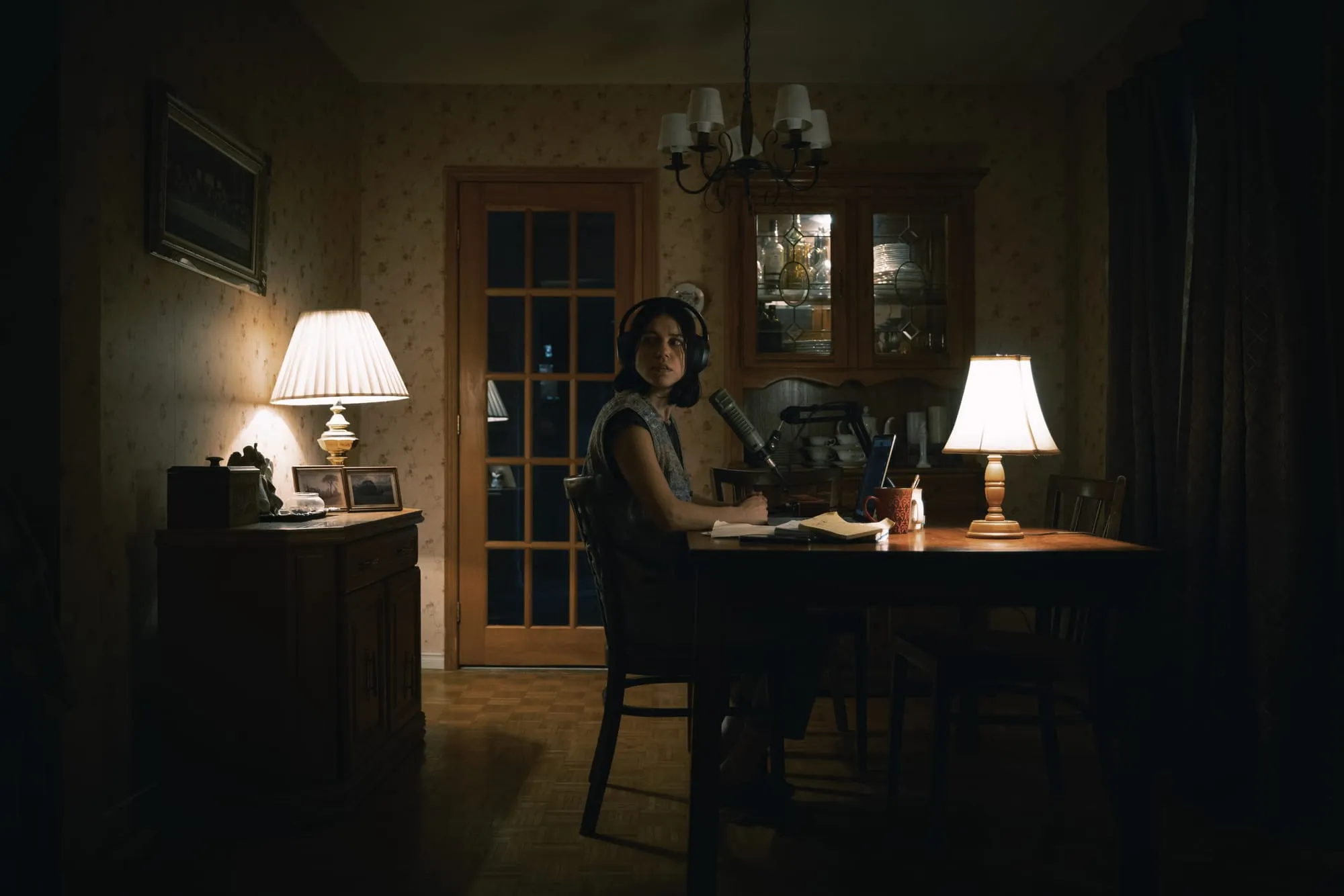
The story follows Evy, a podcaster whose show explores all things eerie and paranormal. Broadcasting alone from her kitchen table, she and her co-host dissect strange recordings and unexplained phenomena. But, when they come across ten particularly unsettling audio files for an upcoming episode, Evy is slowly pushed towards madness.
In a recent Reddit AMA, Tuason—who was recently announced as the director for the upcoming eighth instalment of the Paranormal Activity franchise—discussed his horror influences when building the atmosphere in Undertone, stating:
“Paranormal Activity, for sure. The Blair Witch was the first found-footage film that really scared the shit out of me, and it didn’t need to show anything either.”
Watching Undertone, those influences become clear but not so much in its narrative content as in its technical execution. The film’s meticulously crafted sound design is what truly draws us in. Built for theatres equipped with Dolby Atmos, Tuason uses audio to create a soundscape of unsettling whispers and distorted gibberish that forces the audience to listen more closely than they’d like.
At the same time, Undertone aligns with many of the past decade’s most successful horror films, in which grief, personal loss, and societal dysfunction serve as the genre’s emotional core. Where earlier horror externalized fear through creatures and killers, Tuason and his contemporaries turn those anxieties inward. In other words, like much of modern horror, Undertone trades the typical monster for the metaphor.
The result is a film that feels deeply personal at times and transforms that emotional connection into something terrifying. And in a lot of ways that really worked for me. I loved the internet era folklore, or, “creepypasta”, influence the story embraced. As well as the film’s single location setting which created a real sense of isolation felt by myself and the stories protagonist. But, much like a lot of horror films, the film did a great job of building suspense but struggled to capitalize on it.
Visually, the camera’s slow pans and the wandering tracking shots through the quiet, empty house consistently keep viewers anxiously scanning for something in the peripheral. While the set design and its emphasis on religious paintings and symbols did a fantastic job of creating a house that felt lived in while also contributing to the themes of the film.
From a performance perspective, the story demands a lot from its lead actress, Nina Kiri. Aside from a few back‑and‑forth conversations with her co‑host filtered through a microphone and laptop, Evy moves through the story almost entirely alone. This literal isolation serves the film’s premise and themes, but when the scenes called for emotional intensity, they didn’t always land.
The dialogue between her and her co‑host also lacks the spark needed to sell their connection. The chemistry felt underdeveloped, leaving their conversations more functional than real. It was as if the script seemed more interested in advancing to the more fun unsettling or supernatural moments than in deepening the relationship between its only visible character and the faceless voice on the other end of the microphone. Resulting in a movie that was indeed scary but didn’t have that personal centre I needed to really connect with it.
Still, Undertone stands as an impressive feature debut, and I admire a film that so clearly values and creatively leans into the technical craft of filmmaking. Tuason may not land every emotional beat, but his confidence in sound, pacing, and the mechanics of horror marks him as a director with a sharp understanding of what makes the genre work. It’s a film that deserves to be experienced in a theatre—or at the very least with the best headphones you can find—and it leaves me genuinely excited to see what Tuason does next.