Table of Contents
Fremont, CA, USA - Thursday, February 12, 2026
Cinematographer Dale Campbell has more than two decades shooting commercials, fashion and narrative projects. A last minute TWG Tea ad campaign put his experience to the test, with barely a week to prepare and multiple delivery formats to turn around, while retaining a sharp and cinematic finish.
“The brief for this project was already quite advanced when I came onboard, with about a week and a half until the shoot. It laid out a shot list and a rough storyboard for the ad,” Campbell said.
“A lot of the reference imagery was outside in bright and sunny conditions, but at the time, we were forecasting lots of rain and flat, cloudy skies. In cases like this communication is key, and I like to make sure that everyone involved is aware of any limitations we might encounter. In the preproduction meeting, we discussed this and decided to lean into a different look that embraced the moody weather,” he shared.
Campbell opted to shoot handheld which required a solution that balanced mobility, efficiency and image quality. The result was the Blackmagic PYXIS 12K digital film camera rigged with a Blackmagic PYXIS Monitor EVF Kit for the interior shots and paired with a set of DZOFILM Arles Lustre lenses.
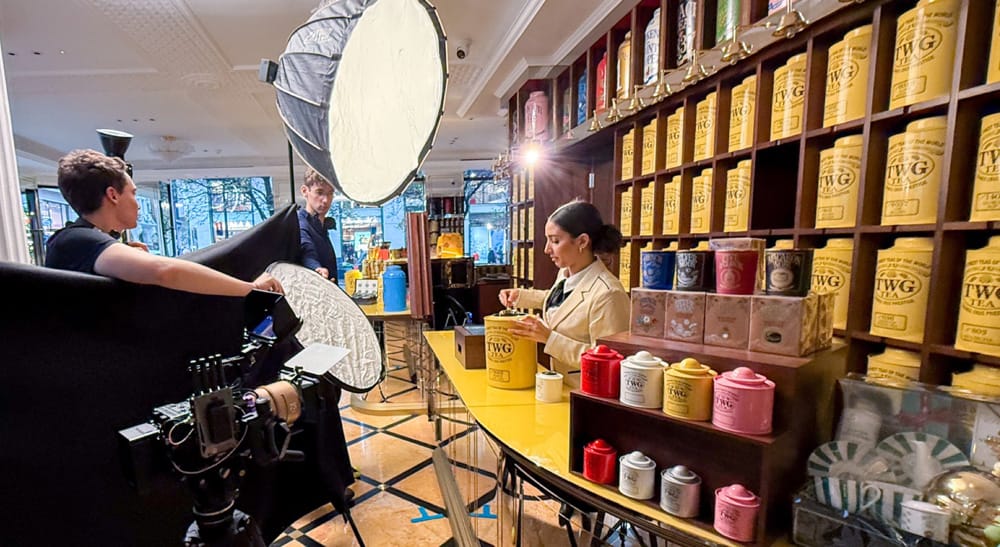
“This pairing allowed me to retain a lot of the quality and characteristics in the out of focus areas but also have a wonderful golden flare profile,” said Campbell. “I wanted enough sharpness to work with different crops for the deliverables.”
A non negotiable in Campbell’s filmmaking arsenal is the accurate representation of skin tones which, in his experience, connects the audience to the image. “This is influenced by the lenses, lighting and makeup, but the PYXIS 12K holds up its end of the equation beautifully,” he enthused. “Skin isn’t a flat homogenous surface; there are reflections from different layers, oils and imperfections, all dependent on how the light is hitting and passing through it.”
While the primary deliverables were vertical for social media, there was also a desire to have a 16:9 version available. “I always try to shoot in an intentional way, and ideally, I like to fully commit to the final deliverable aspect ratio,” he noted. “However, with requirements for both, shooting in vertical from the outset wasn’t an option.”
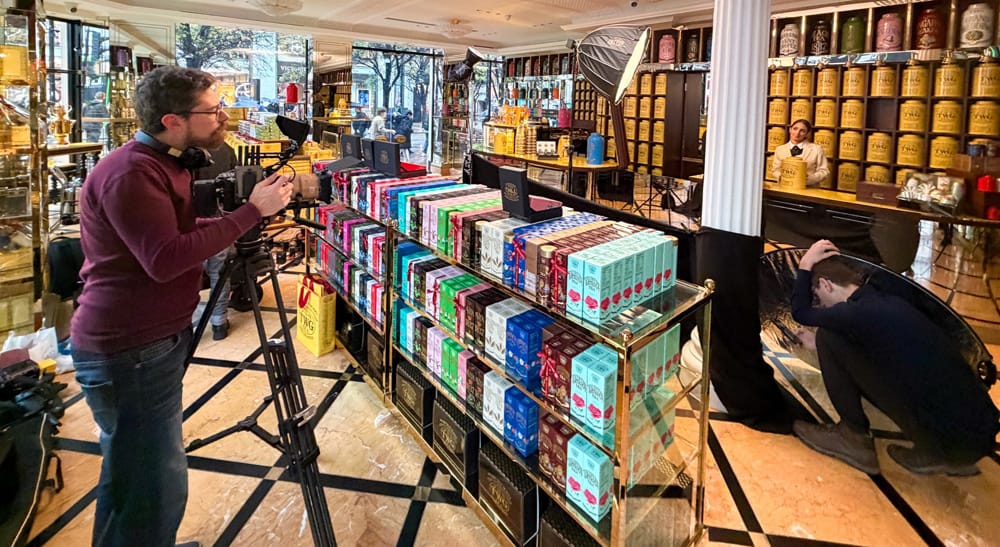
The shoot was based between TWG Tea’s Oxford Street location and a busy high street for the exterior shots. While this created the intended atmosphere for the campaign, it also surfaced some challenging conditions to navigate in camera.

Blackmagic Design’s RGBW sensor design lets the camera scale its raw recording resolution without changing the sensor area used, so Campbell could keep the same angle of view while choosing a more manageable capture size. For maximum flexibility and image quality, Campbell chose to shoot in 8K at 50 fps.
“There was less compromise between the vertical and horizontal framing because we shot open gate,” Campbell explained. “I set my camera up with frame guides on screen to show a 9:16 area visible for vertical but left an amount of transparency to see the rest of the image being captured.”
He added, “As a rule when framing for 9:16, I tend to leave more headroom than you would usually have for the same shot in 16:9. I’d then punch in to get the composition where I want it, so the extra resolution really helps.”
Campbell’s involvement in the campaign also extended to post production, a part of the process that he planned for from the outset. “I’ve been living and breathing a Blackmagic RAW workflow for many years now, so I know exactly what I’m getting in post,” he noted. “Shooting in 8K 3:2 gave me room to protect for 9:16 delivery in post and still pull a clean 16:9 image, all while keeping the data rates manageable.”
With back to back projects, Campbell employed a travel friendly workflow that let him start the assembly edit immediately. “This project landed right next to a location shoot in Ireland, so I started my assembly edits in DaVinci Resolve for iPad using the DaVinci Resolve Speed Editor,” explained Campbell. “On projects like this, I can complete some deliverables on the go. And because I host my projects using Blackmagic Cloud, I can easily jump back into my main edit and finishing system once home if needed.”
Capturing most of the look in camera created an easy pathway to color grading. “I addressed some fixes using the deflicker tool and tracked Power Windows, however, the image didn’t need much manipulating. The lack of that struggle says a lot about the image this camera and sensor produce,” he concluded.
Press Photography
Product photos of PYXIS 12K, DaVinci Resolve Studio, DaVinci Resolve for iPad, DaVinci Resolve Speed Editor and all other Blackmagic Design products are available at www.blackmagicdesign.com/media/images
About Blackmagic Design
Blackmagic Design creates the world’s highest quality video editing products, digital film cameras, color correctors, video converters, video monitoring, routers, live production switchers, disk recorders, waveform monitors and real time film scanners for the feature film, post production and television broadcast industries. Blackmagic Design’s DeckLink capture cards launched a revolution in quality and affordability in post production, while the company’s Emmy™ award winning DaVinci color correction products have dominated the television and film industry since 1984. Blackmagic Design continues ground breaking innovations including 6G-SDI and 12G-SDI products and stereoscopic 3D and Ultra HD workflows. Founded by world leading post production editors and engineers, Blackmagic Design has offices in the USA, UK, Japan, Singapore and Australia. For more information, please go to www.blackmagicdesign.com