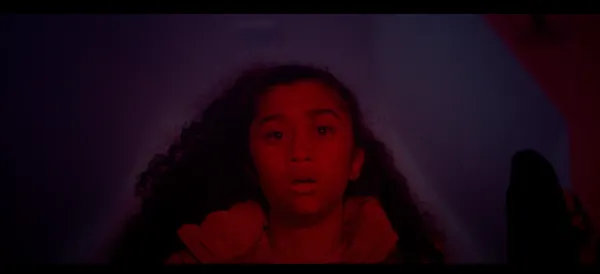
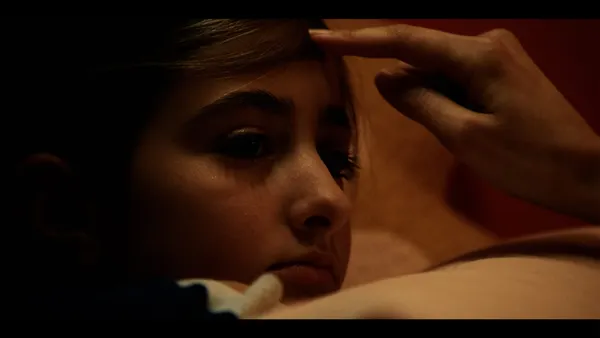
A taxi veers off-course into dark fields. A passenger tries to work out what is happening, and instead finds himself flooded with images from childhood nightmares he had long since buried. That ride became Night Ride, a dialogue-free short in which a boy is taken from his home in the middle of the night by an enigmatic underground, driven across an empty city while faceless pursuers close in behind them.
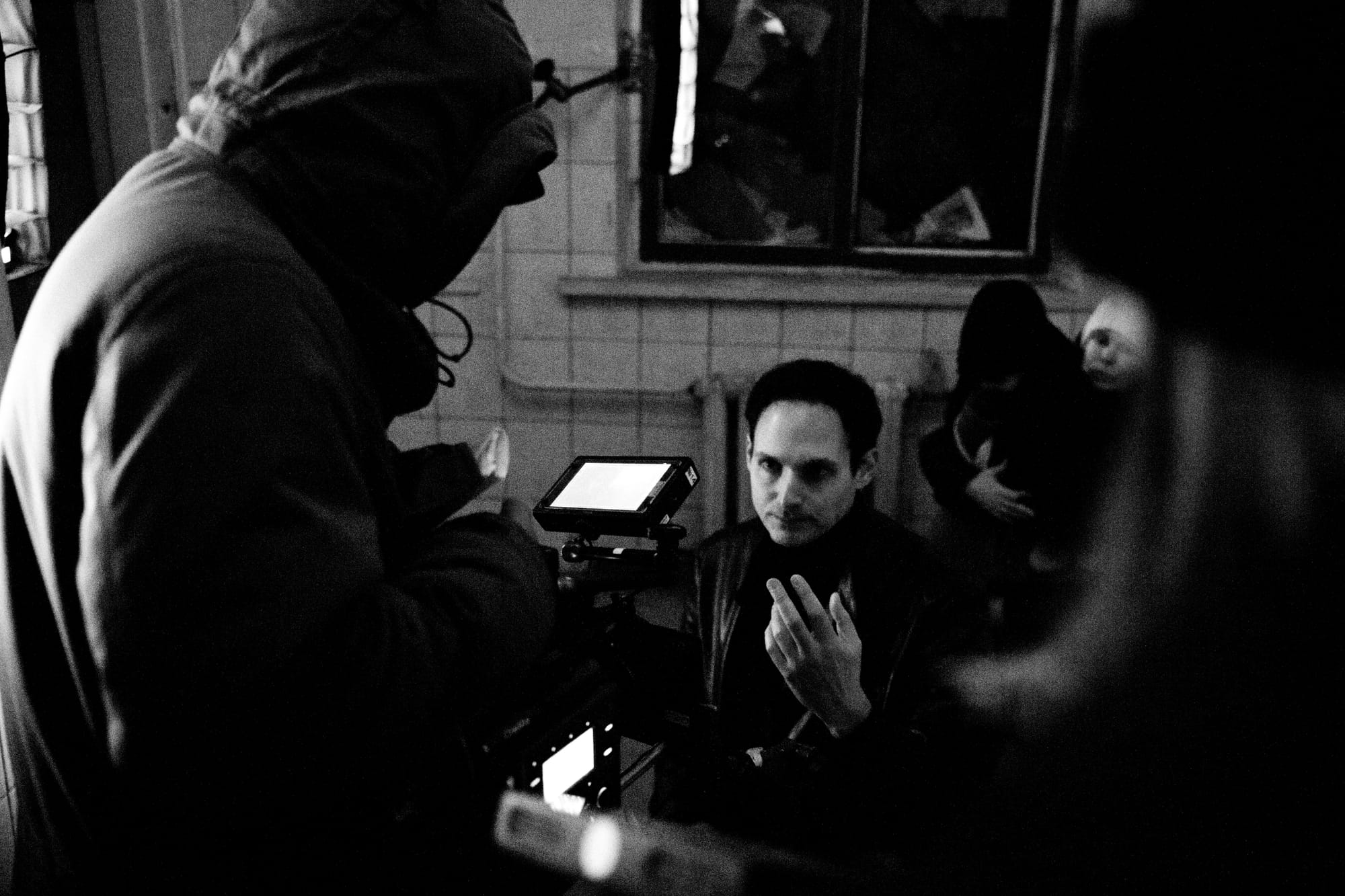
Writer-director-producer-composer Don Barak, who also plays the Driver, shot the film in Ukraine during COVID with a cast and crew working partly through translators, in one of the coldest European winters in years, with war looming over the production and later reshaping its post. Produced and cast by Ukrainian director Oleksandra Brovchenko, photographed by Andrey Tartyshnikov, and anchored by a remarkable, largely silent performance from young Ivan Merzlyakov, Night Ride sits between dystopian science fiction, surrealism and dark fairy tale — and trusts its audience to find their own way through.
Key Takeaways
- Night Ride omits dialogue entirely because, as Barak notes, most people cannot read in dreams — music and silence carry the characters' reconnection to their emotions.
- The camera grammar tracks the Boy's maturation: wide-lens low angles at the start, eye-level and shorter lenses as he gathers knowledge.
- Barak credits a found mindset of "ignorance" — not questioning what couldn't be done — for an all-night, multi-location shoot that broke the usual rules of short filmmaking.
Barak spoke with us about anxiety as source material, directing a five-year-old through an all-nighter, and why ambiguity is the point.
Interview
What drew you to make this film, and why this story, why now?
I was troubled by these uncontrollable events: the uncertain future, getting older. I was facing difficult personal and professional life choices. Suddenly, the taxi inexplicably veered off-course into dark fields. As I was trying to make out what was happening, blocked images from my childhood nightmares came to my mind. That sparked the idea for Night Ride.
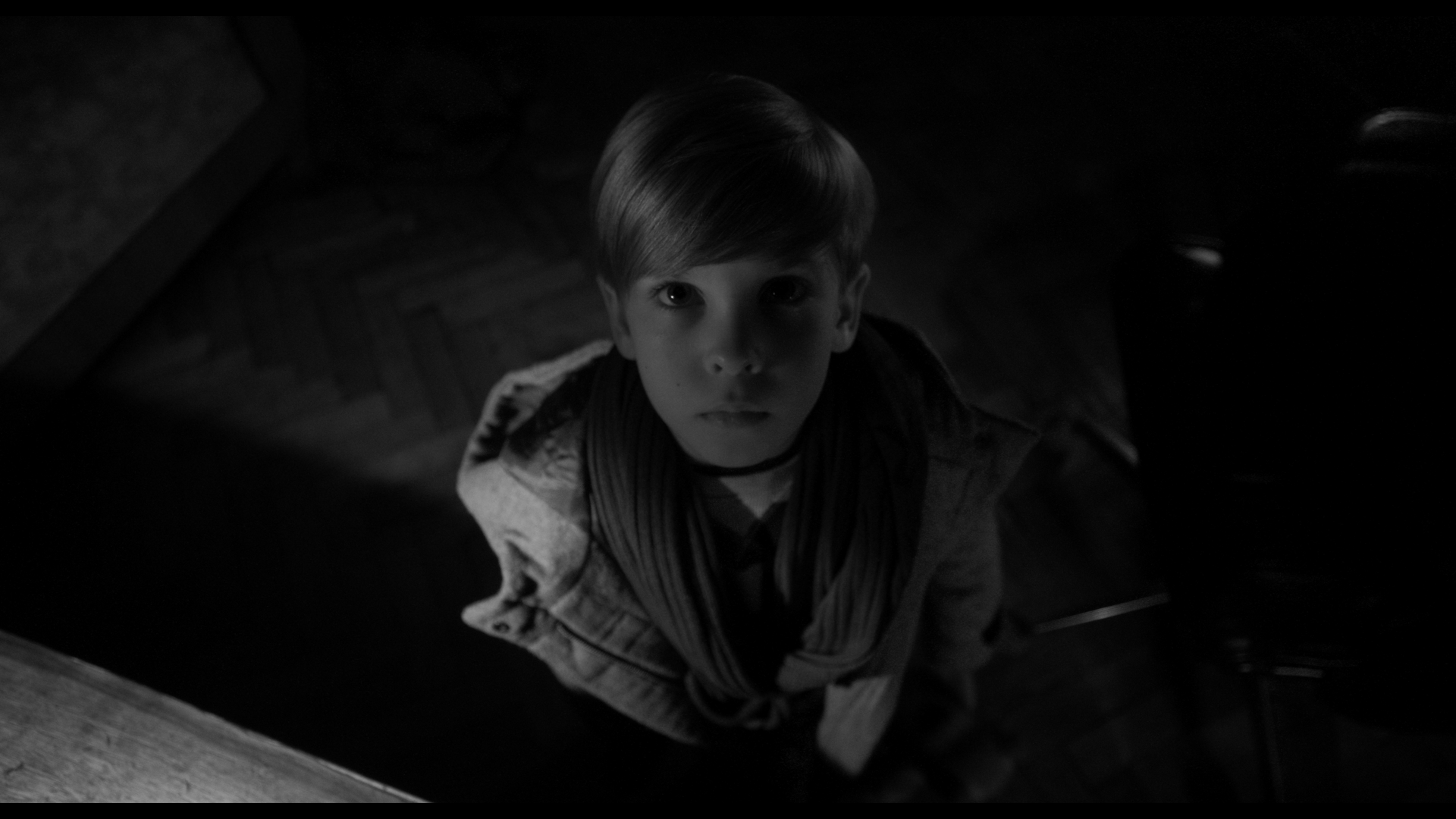
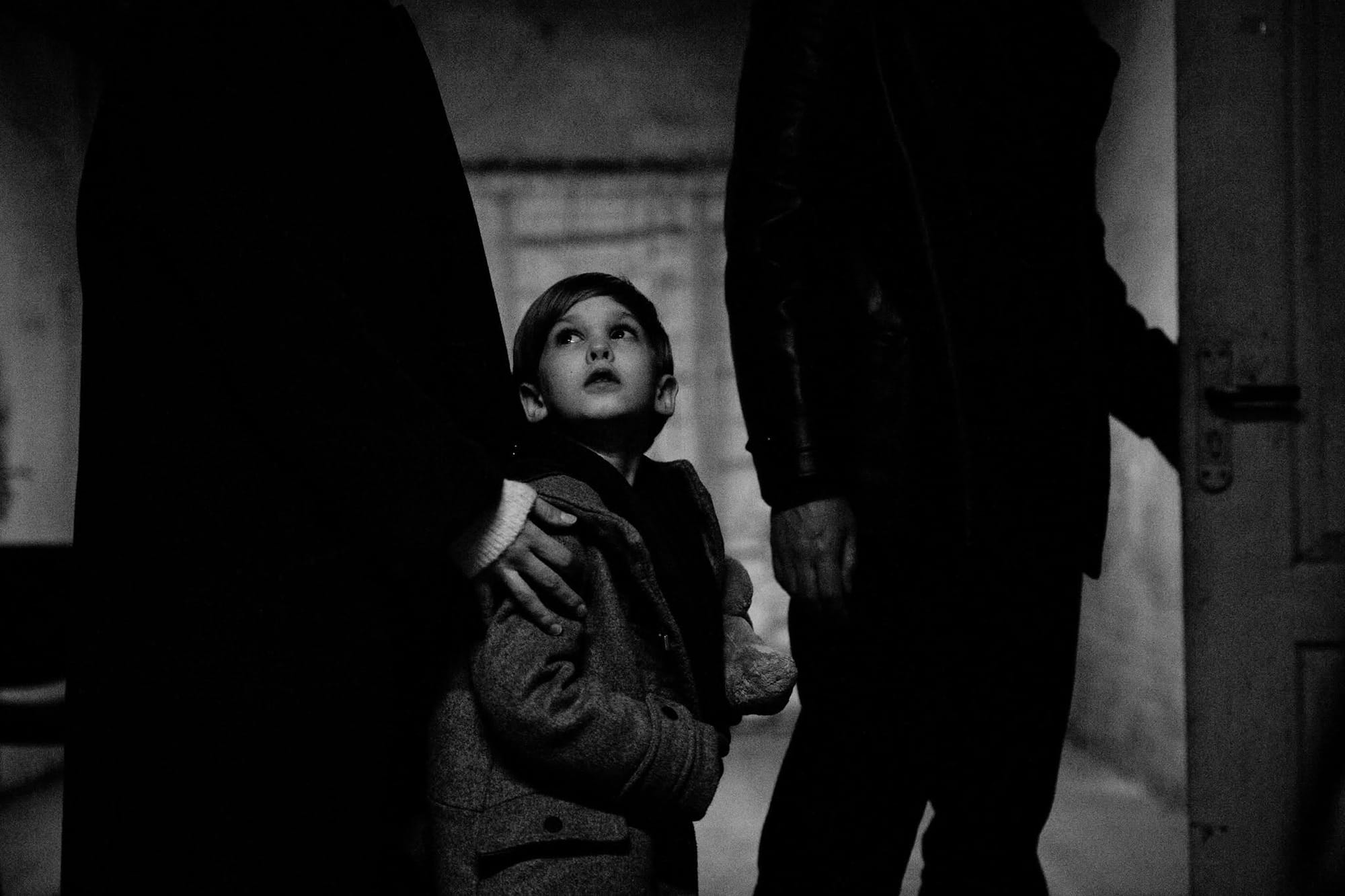
I wanted to explore my anxiety and reach a possible coping resolution against the unknown, a way to move forward. Stemming from the enigmatic human psyche, I created Night Ride as symbolic and multifaceted, a different take on the dark coming-of-age story. Over one night, a boy passes through symbolic moments of existential fear. The Boy being taken represents my desire to keep naivety, hope and my inner child. Sitting in the backseat, he has no control and doesn't know where he is going, while the adults tower over him, seeming monstrously scary. As his journey continues, he gathers pieces of knowledge about his situation, becomes more aware and matures. I kept following his perspective and reflected this inner transformation by starting with wide-lens low angles and moving to eye-level angles with shorter lenses.
Meanwhile, the Driver is traumatized, ridden with guilt by previous attempts to find the "right" Boy. Like the Girl, he operates by following orders, wishing he could be somewhere else, but eventually his skepticism turns into hope. He accepts his role to save his "new family," as the Girl completely sheds her strict demeanour and connects to her emotions, accepting a mother role.
I set Night Ride in a nightmarish world to represent dread in the human psyche, in an allegorical fairytale. As evidence shows that most people cannot read in dreams, I omitted language and dialogue to signify it is a dreamscape. The characters' silence and mechanical motions reflect shock and repressed emotions when facing fear. Instead, musical cues portray the progress of their reconnection to their emotions. The retro-future dystopia and the use of early cinema aesthetics with modern techniques express both history repeating itself with the current war and the cyclical nature of trauma. In the end, Night Ride is a story of overcoming anxiety through acceptance and love, and taking a leap of faith in the hope that even after tragedy, life can reemerge.

What surprised you most about the filmmaking process, creatively or logistically?
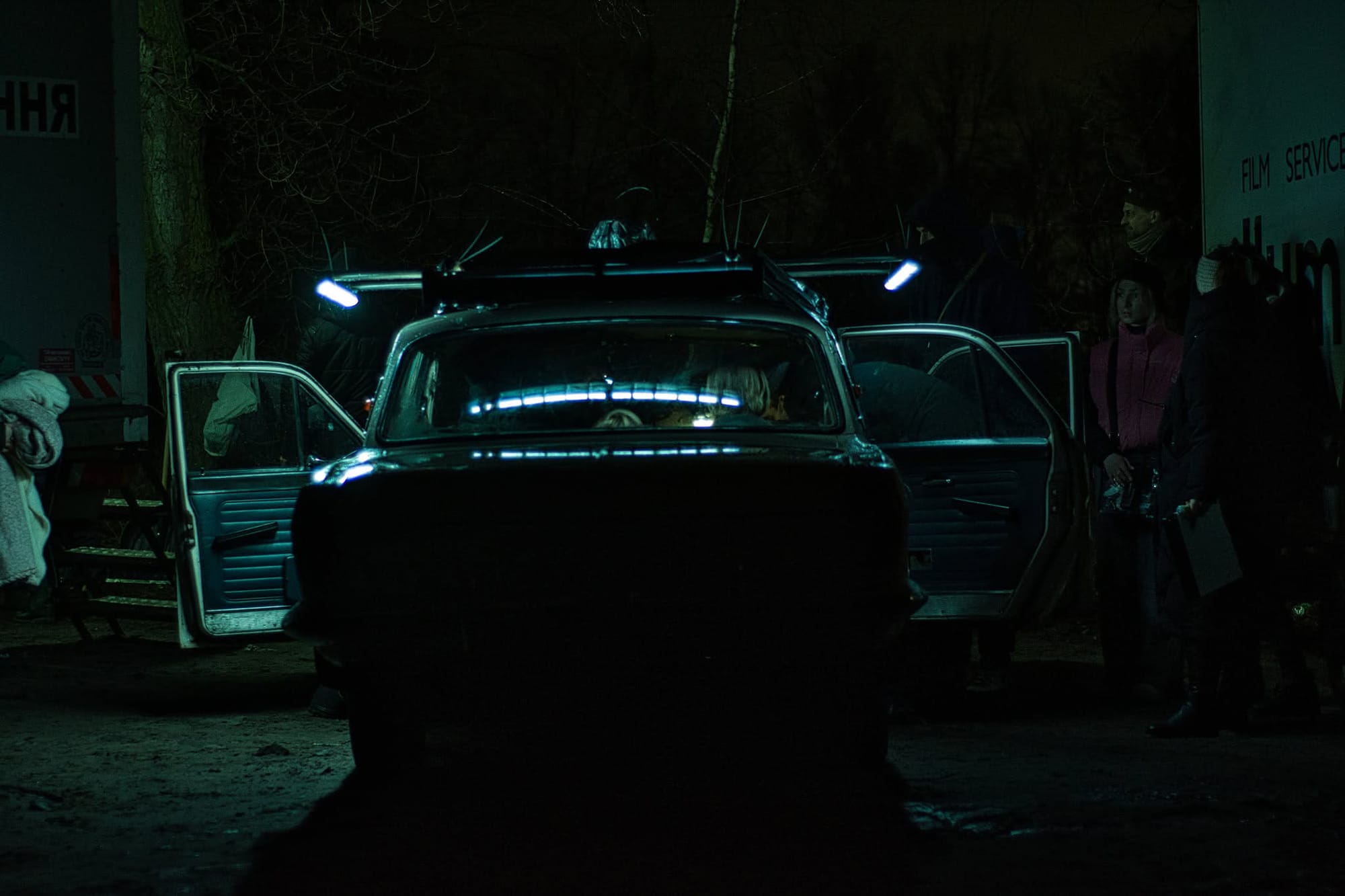
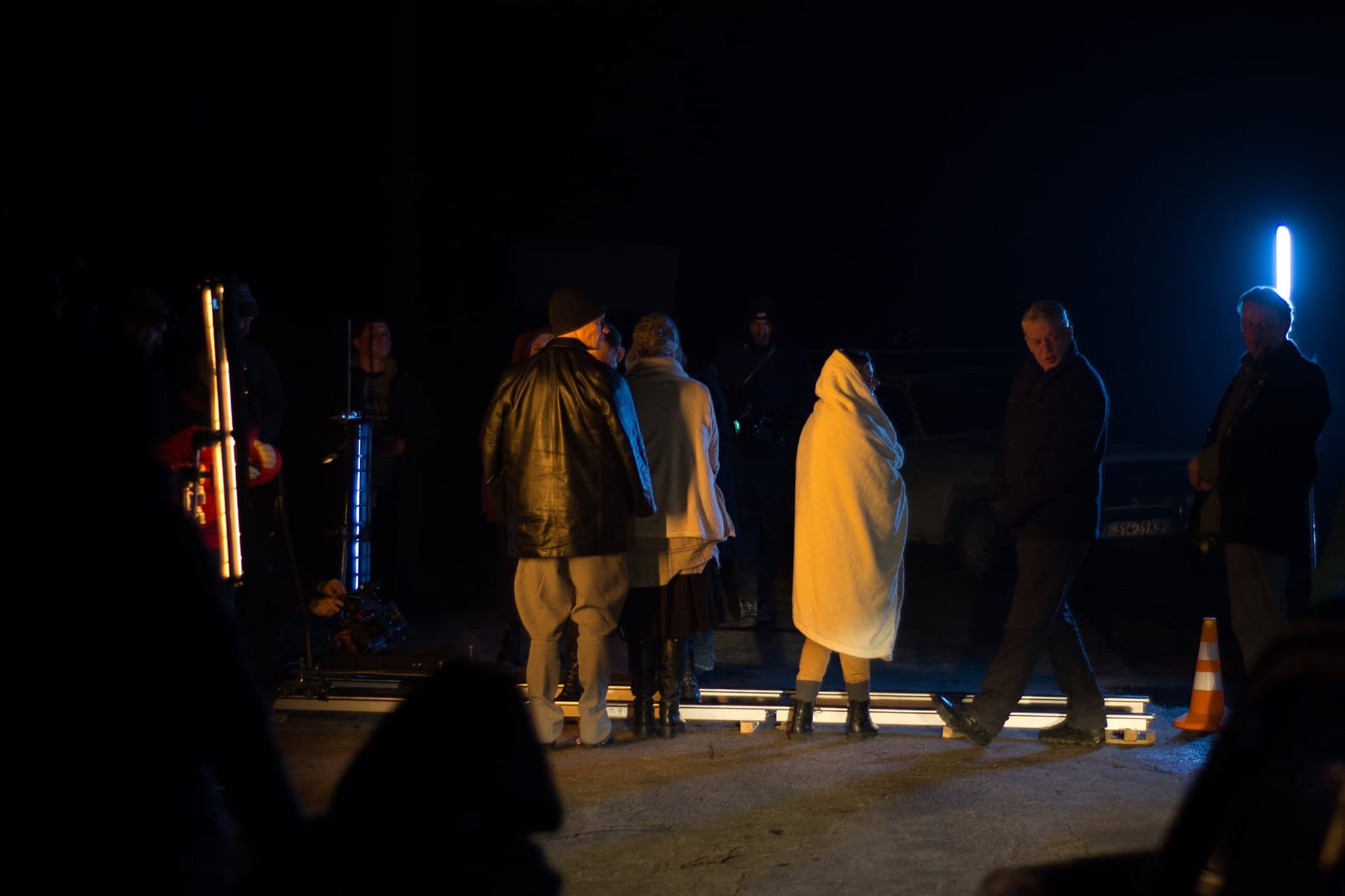
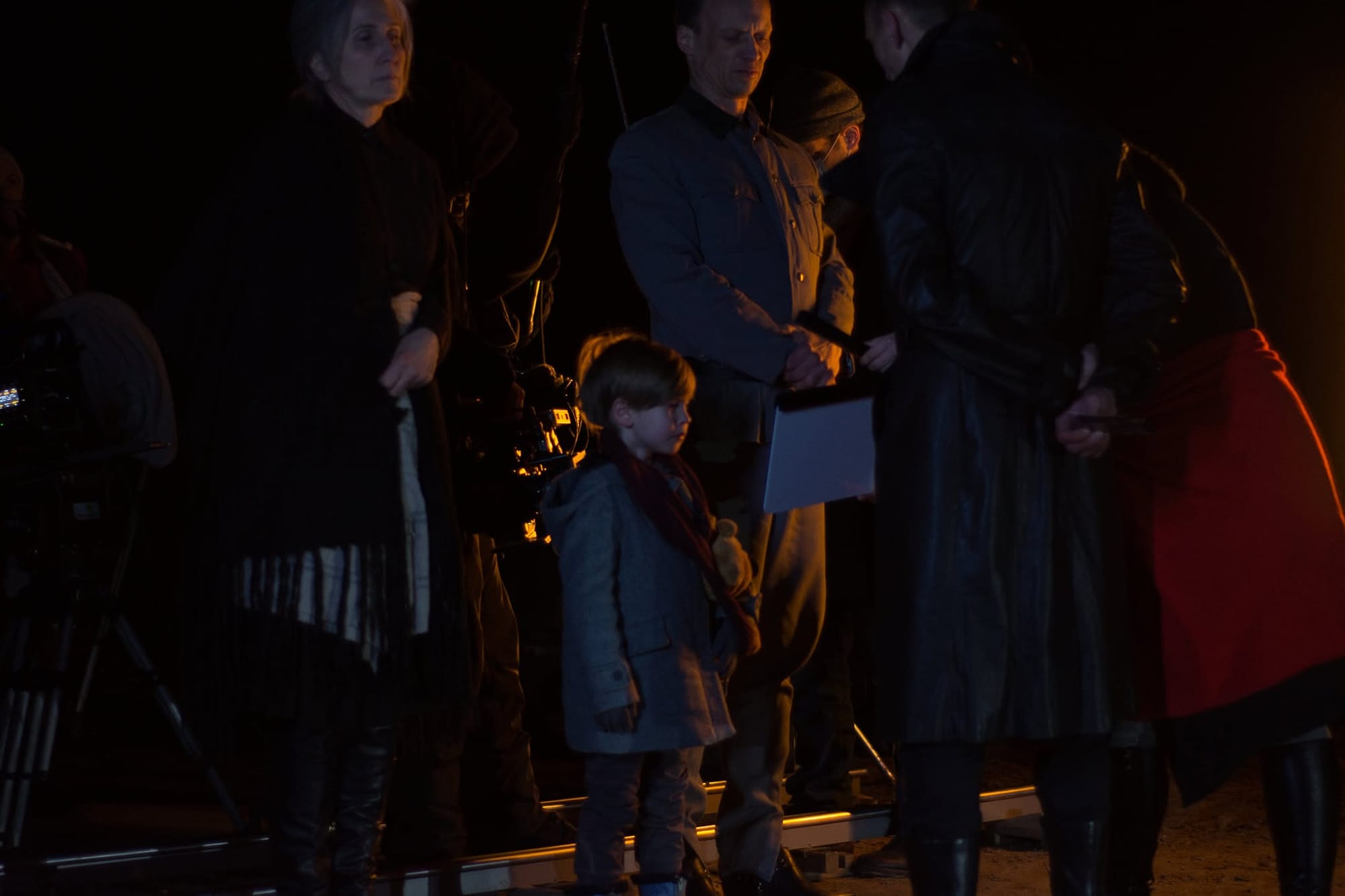
On this production, every day was a logistical challenge and a surprise, and we were immensely lucky. While Oleksandra is a local filmmaker, I had to produce and direct in a foreign country with cast and crew who had to use translators. It was during COVID, with the war looming every second — it did greatly affect our post-production — a completely different production system and crews, and all-night shoots in one of the coldest winters Europe had experienced in years. You can definitely see me trying to emote with a frozen face.
Vaccines had not even been delivered yet. Every day was a meteorological risk. One sunny day we went to pick wardrobe from a studio wardrobe department, and when we came out to the car, everything was covered in snow. It was insanity from any angle, but this Wild-West feeling was also exciting and liberating.
This production really reminds me of an old Orson Welles interview: asked where he got the confidence to direct "Citizen Kane," he simply replied, "Ignorance." There were so many pre-production meetings where I was told that certain things could not be done for one reason or another, and I genuinely — especially being a foreigner — said, "Why not?" and broke down simply how I saw it happening, to the production team's sighs. Even during filming, I heard that the team called me "a crazy director," and I couldn't understand why, as we filmed everything with respect and friendliness. Oleksandra promised me it was a compliment. Only after I watched the first assembly cut — the full adventure with the entire ensemble, the car chases, the various locations, basically breaking the short film "rules" of keeping it simple — I turned to her and said, "It's pretty insane that we actually did it." She just smiled and said, "Exactly."
Had I known what it would take, I'm fairly certain I'd have done something easier. I realized then the importance of that ignorance for the creative process.
Creatively, something that changed how I saw the story was that my executive producer and agent, Schaul Scherzer, gave me an interpretation I hadn't thought of, and it still worked. It validated that the ambiguity works well for this film. It really allows people to reveal themselves through their perspective, even if some said, "I have no idea what I saw." That's dreams for you.
What moment in the film feels most like you, or like something only you could have made?
This is a hard one, asking me to be overly self-aware. In a sense, a piece that was written in 20 minutes after a flood of tension and childhood memories — it's all me.
I've been told, however, that the angles and pacing feel like my previous work, and possibly the moments of looking into the abyss, the darkness, not knowing what's there. Many things I've written before dealt with that constant struggle between rationalism and logic and mysticism, and with battling the uncomfortable ease of nihilism. Maybe there's something there.
What was the hardest creative decision you made while making the film?
That's an easy one. We had to kill a cast member. No, I'm joking. During pre-production we had to choose between several locations for some of the scenes, taking production time into consideration, meaning moving between locations. Each location emanated a good but different feel. I had to choose the ones that my guts (instincts), heart (emotional cohesion) and mind (symbolism) all agreed on.
But maybe the hardest was the tone. I was constantly juggling a coherent thriller/mystery hero's journey plot, which would make the film easier to digest, with the incoherent surreal, dream-logic and allegorical elements, which would make it more special and personal — all while keeping momentum and a runtime that would give it a shot at festivals.
How does your film fit within, or push the boundaries of, its genre or form?
Night Ride sits somewhere between dystopian science fiction, surrealism and a dark fairy tale, and also somewhere between arthouse and genre cinema. Its distinction is perhaps less its genre than its approach to storytelling. It's a dialogue-free film, in which the audience discovers this strange, nightmarish world largely through the eyes of a five-year-old boy. Rather than explaining what's happening, I wanted the camera, the atmosphere and the characters' actions to do the storytelling.
I love cinema that trusts the audiovisual to communicate things words cannot, and that allows mystery and ambiguity to coexist with a compelling narrative. It welcomes people to experience and interpret through a naive child's perspective. I wanted to create a world that feels both alien and strangely familiar, where the surreal isn't an escape from reality but a way of looking at it from a different angle.
What is the greatest strength of independent filmmaking, and what lesson would you share with others?
Freedom. We all know what big productions look like, and often they are made by committee and lose their edge. Night Ride is a personal vision, inspired by my own fears and childhood nightmares, and people simply connected to it and followed. I didn't need anyone's approval.
It has taken a huge risk with distribution and even with some festivals — I've been told by several distributors that it's too unique or too sophisticated, when short films are usually expected to be straightforward — but it also opened up a lot of directing proposals and opportunities as a calling card for producers looking for something different.
If you never get at least one chance to create the thing that is "you," you'll just stay unfulfilled, hoping that one day you'll "get the opportunity" to do it. You should just do it, whenever you can.
I'd also add that I couldn't have done this without Oleksandra, who acted as producer and, at times, translator with the crew. The fact that she is herself such a creative, talented and lauded director and still agreed to put that aside for several months for this crazy ride is something that has to be praised.
What does it mean to have your film selected for FilmQuest, and where do you see the film going next?
It's a great honor. FilmQuest is a creative powerhouse with an incredible eye for talent, having championed films that went on to win Academy Awards. What I find remarkable is that FilmQuest doesn't seem to treat a festival selection as a one-off event. From what I've seen, it has built an alumni community that keeps in touch, supports one another and keeps making connections long after the festival is over, like a priceless creative hub. There's something incredibly encouraging about being welcomed into a community that genuinely cares about the art form and wants to see its filmmakers thrive.
I'd love for Night Ride to continue its journey through festivals and reach audiences around the world. It's the kind of film that leaves room for interpretation, and I'm curious to see how people connect with it. I'm also interested in seeing where the world of Night Ride drives me next, with the feature adaptation, and I've already had discussions about potential sequels. Beyond that, I'd love for it to open doors to new collaborations and new possibilities for the story.
Main Cast & Crew
- The Boy — Ivan Merzlyakov. Born in 2015, a year after his family was forced to leave occupied Luhansk, Ukraine; now based in Kyiv. Since beginning acting at age five he has appeared in 25 projects, including the feature Sashenka (dir. Oleksandr Zhovna) and the shorts Mom (dir. Hanna Hnatenko-Shabaldina), Lanfren-Lanfra (dir. Yaroslava Velychko) and Night Ride. He also dreams of becoming a roboticist.
- The Girl — Olha Tsitsilinska. BFA in Film and Theatrical Acting from the Kyiv National Theatre, Cinema and Television University; ensemble member at Pechersk Theatre and Maisternya Leny Lazovich Theatre. Stage work includes Me, War and Plastic Grenade, The Libertine, Gryts Stand Up and While We Wait. Screen work includes The Witches (2018), Papik 2 (2020) and a starring role in Kira (2023, dir. Anastasia Obodovska). A professional acrobat and skater.
- The Captain — Sergiy Volyanovsky. One of Ukraine's most prolific film and TV character actors, with over 100 titles across action, romance, horror and comedy, including the crime-action series Incorrigible (2017).
- Writer / Director / Producer / Composer / Actor, "The Driver" — Don Barak. International-award-winning writer and director for film and theatre, published author, composer, producer and actor, based in LA, Tel-Aviv and London. Graduate of TAU Tisch School for Film & Television and the Torino Film Lab. His book The Short Screenplay Book was published by Tel-Aviv University and the Israeli Writers' Guild. He has written with Eran Riklis, United Kings Ltd., Academy Award winner Sharon Maimon and The Paz Brothers. 2026 also marks his theatrical acting premiere in the comedy Jaffa 2. instagram.com/barakdon
- Producer / Casting Director — Oleksandra Brovchenko. Internationally awarded Ukrainian director, screenwriter, producer, editor and visual artist. BFA from Kyiv National Karpenko-Kary University and graduate of the Torino Film Lab; screened at A-class festivals including Molodist. She took an active part in the 2014 Maidan revolution as one of the filmmakers documenting the protests, and has spoken about that experience at consulates and embassies. Creator and director of social campaigns for the Council of Europe in Ukraine, Social Action and La Strada; co-founder of the Ukrainian Directors' Guild; currently based in the UK.
- Cinematographer — Andrey Tartyshnikov. Latvian-born Ukrainian cinematographer who began at 15 as a camera assistant on The Return of the Musketeers, or The Treasures of Cardinal Mazarin (2009). Over a hundred productions across music videos and commercials for Samsung, Rimowa, Jägermeister and Jo Malone, plus TV series and films. Based between Berlin and Kyiv.
- Art Director — Ehlvira Belista. Siberian-born, she began at 13 at a local children's TV show and graduated in Art Direction for Film from Kemerovo University of Culture and Arts, receiving the Grand Prix at the 2008 Siberia Expo Fair for Social Advertising. She moved to Ukraine in 2014 for political reasons. She believes prop and art design are not background but a way to reveal the deep layers of complex characters.
- Line Producer — Yevhen Ostrovsky. Line and executive producer across Ukrainian and international film, television, advertising and clips, beginning in 2010 with the largest documentary project in Ukraine, Maidan; more than 100 hours of television content created under his leadership.
- Co-Editor / Associate Producer — Joe Carugati. Award-winning editor across commercials, digital series, long-form narrative and music videos, drawn to filmmakers with vision and a willingness to collaborate.
Filmmaker Opportunities
💛 Fund your next project with fiscal sponsorship
Have a project in the works? As a 501(c)(3) nonprofit, the Cinematography for Actors Institute can accept tax-deductible donations on your film's behalf — a door-opener for grants, foundations, and supporters who want to back your work. We've serviced over 100 projects to date and helped route over $800,000 in funding to filmmakers. Explore fiscal sponsorship →
📬 Grant deadlines and festival opportunities, straight to your inbox
The CFA newsletter rounds up grants, festival calls, and community news for independent filmmakers — the kind of opportunities that are easy to miss and painful to miss. Join the newsletter →
🎬 Focus on the creative — we'll help with the logistics
Production Management, CFA's newest member program, launches this November: production insurance and workers' comp, payroll, film permits, gear rental coordination, SAG-AFTRA compliance, contract drafting, production consulting, and crew recommendations — handled by a team of working filmmakers, à la carte or all in, in partnership with Creative Access Group. It's waitlist-only until launch. Join the waitlist →
League of Filmmakers is published by our parent organization, the Cinematography for Actors Institute — a 501(c)(3) dedicated to education, community, and capital for underrepresented filmmakers and actors. Learn more about CFA →