
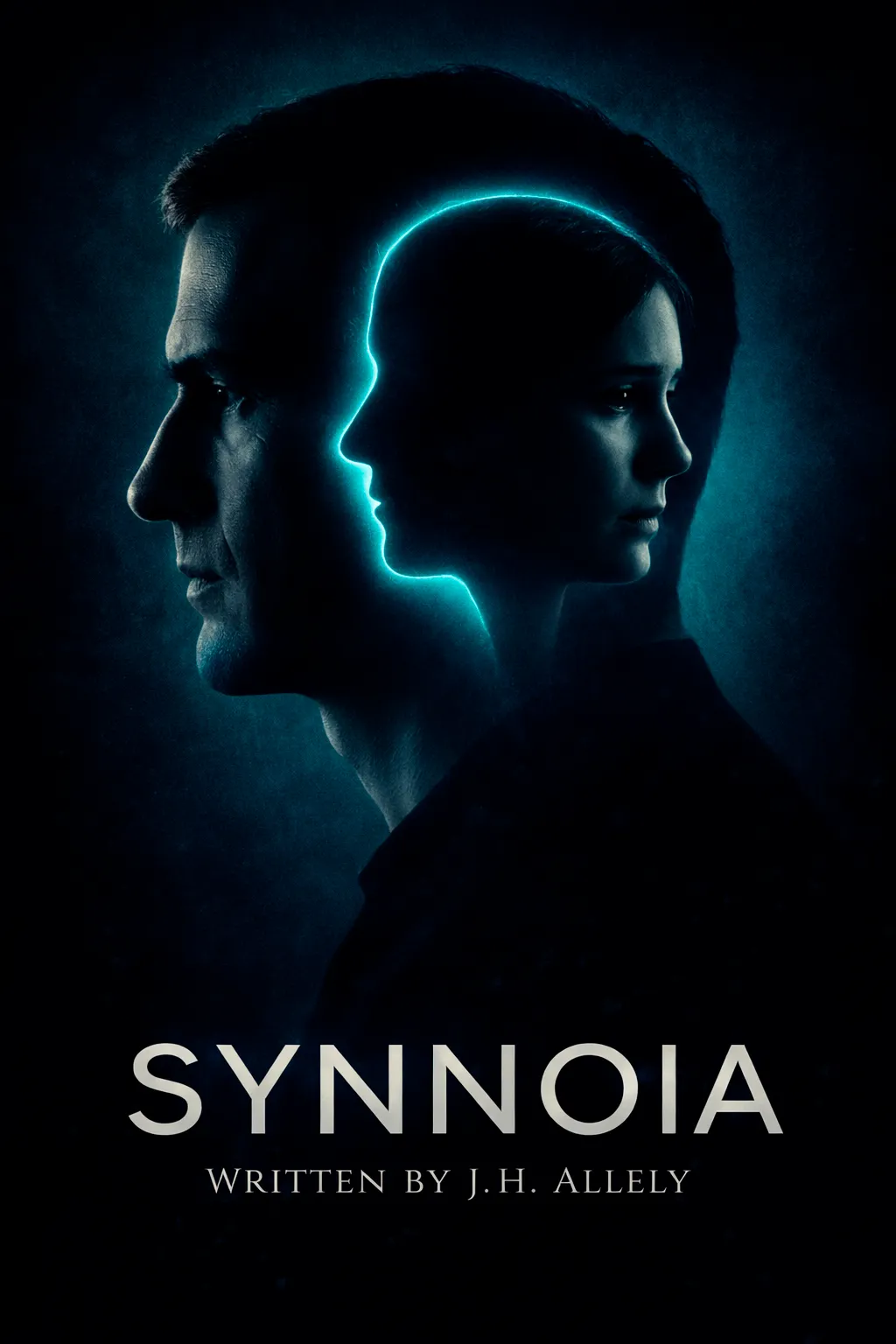
Marcos survives the accident. His wife, Eva, does not — not entirely. Left in an irreversible coma, she is offered back to him through SYNNOIA, a technology that transfers her consciousness into his body so she can see, hear and feel through him. What begins as a victory over death settles into something closer to confinement: Eva loses her body, her privacy, and any place of her own, while buried truths about the marriage rise to the surface. Spanish screenwriter J. H. Allely writes emotional science fiction built on high-concept moral dilemmas, and SYNNOIA is a clean statement of that method — the technology is simple, the consequences are not.
The screenplay arrives at FilmQuest as a finalist and as an unproduced work actively seeking production, which gives the conversation an unusual candor. Allely talks about rules rather than shoots, about development rather than post, and about a contained design — five principal characters, three primary environments, selective VFX — built so that the idea, not the budget, carries the scale.
Key Takeaways
- SYNNOIA is a FilmQuest finalist screenplay with 17 awards and 44 recognitions internationally, currently seeking a director and production partner.
- Allely fixed the rules of the technology early and refused to break them for convenience, forcing every scene toward emotional consequence.
- The script is engineered for contained independent production: five principal characters, three primary environments, selective VFX, value carried by performance, cinematography and sound.
Allely spoke with us about grief disguised as love, the moment Eva wakes inside her husband, and why the ending had to belong to her.
Interview
What drew you to write this story, and why this story now?
SYNNOIA began with an uncomfortable question: what happens when the fear of losing someone disguises itself as love?
I wanted to explore grief through science fiction, but not by making technology the villain. Technology simply makes the emotional conflict impossible to hide. Marcos believes preserving Eva means saving her, yet she loses control of her body, her privacy, and even her ability to be alone.
The story became a way of examining the difference between love and possession, and whether loving someone also means accepting their right to leave. That question feels increasingly relevant at a time when technology promises to preserve more and more of who we are.

What surprised you most about the process, creatively or logistically?
As SYNNOIA is currently an unproduced screenplay, it has not yet gone through a shooting or post-production process. The biggest surprise came during writing and development.
What began as a science-fiction idea gradually became a much more intimate story about consent, grief and possession. The more I developed the rules of SYNNOIA, the less interested I became in the technology itself and the more interested I became in what it revealed about Marcos and Eva.
That shift shaped the entire screenplay: the technology became simple, while the emotional consequences became increasingly complex.

What moment in the film feels most like you, or like something only you could have written?
The moment when Eva wakes inside Marcos feels especially close to the kind of storytelling I want to create. She has survived, but she cannot close her own eyes, cannot move independently, and can only experience the world through the person who decided to preserve her.
Marcos initially sees this as an act of love. Eva experiences it as the disappearance of her autonomy. That contradiction — something emotionally beautiful on the surface becoming morally disturbing underneath — is very much at the heart of the stories I want to tell.

What was the hardest creative decision you made on the script?
The hardest creative decision was finding the right balance between understanding Marcos and judging what he has done. I never wanted him to become a conventional villain. His decision comes from grief, fear and love, but love does not automatically make a decision ethical.
The ending was particularly delicate. It needed to complete Marcos's emotional journey without turning his final choice into a romantic gesture. The story ultimately had to belong to Eva's freedom rather than Marcos's loss.

What tool, technique or mindset shift helped most during development?
Because SYNNOIA has not yet been produced, the most useful technique during development was establishing very clear rules for the technology and then refusing to break them for convenience.
Once those rules were fixed, every scene could focus on their emotional consequences. I also deliberately designed the screenplay around a contained production model: five principal characters, three primary environments, a limited number of key visual elements, and selective VFX. That limitation became creatively useful rather than restrictive.

What is the greatest strength of independent filmmaking, and what lesson would you share with others?
The greatest strength of independent filmmaking is the freedom to build a story around an idea rather than around scale. A film does not need a large world to explore a large question.
SYNNOIA was conceived with that principle in mind. Most of its production value can come from performance, cinematography, sound and a few memorable visual elements rather than expensive spectacle.
The lesson I would share is simple: limitations can become part of the identity of a project. Instead of asking how to make an independent film look bigger, sometimes the better question is how to make the idea feel bigger.

What does it mean to have SYNNOIA selected as a FilmQuest finalist?
Having SYNNOIA named a FilmQuest finalist as an unproduced screenplay is particularly meaningful to me because FilmQuest understands genre storytelling while also valuing the human ideas underneath it.
SYNNOIA has received recognition internationally, but being a finalist here feels like an important validation of what the project is trying to achieve: emotional science fiction that can work as genre while still asking difficult questions about love, identity and consent.
I also hope FilmQuest can become another step toward moving the screenplay from the page into production.

Where do you see this film going next?
The next step for SYNNOIA is production. I am currently looking for the right production partner and director to develop the screenplay while preserving its emotional and moral core.
The project has already built an international track record as a screenplay, with 17 awards and 44 recognitions, including its FilmQuest finalist placement. I would now like that validation on the page to become momentum toward the screen.
The goal is to produce an ambitious but contained short film with a strong festival strategy, and ultimately use SYNNOIA to build relationships with filmmakers and producers interested in emotionally driven science fiction. At the core of all my work is a desire to use genre to reveal the human choices we would rather not confront.
Main Cast & Crew
- Writer: J. H. Allely — a Spanish screenwriter focused on emotional science fiction, psychological drama, and high-concept moral dilemmas. His work uses genre and technology to expose intimate human conflict and build stories around difficult moral choices. | Instagram
- SYNNOIA is currently an unproduced short screenplay seeking production. No director or cast is attached; the project is open to collaboration with producers and filmmakers interested in bringing it to the screen.
Filmmaker Opportunities
💛 Fund your next project with fiscal sponsorship
Have a project in the works? As a 501(c)(3) nonprofit, the Cinematography for Actors Institute can accept tax-deductible donations on your film's behalf — a door-opener for grants, foundations, and supporters who want to back your work. We've serviced over 100 projects to date and helped route over $800,000 in funding to filmmakers. Explore fiscal sponsorship →
📬 Grant deadlines and festival opportunities, straight to your inbox
The CFA newsletter rounds up grants, festival calls, and community news for independent filmmakers — the kind of opportunities that are easy to miss and painful to miss. Join the newsletter →
🎬 Focus on the creative — we'll help with the logistics
Production Management, CFA's newest member program, launches this November: production insurance and workers' comp, payroll, film permits, gear rental coordination, SAG-AFTRA compliance, contract drafting, production consulting, and crew recommendations — handled by a team of working filmmakers, à la carte or all in, in partnership with Creative Access Group. It's waitlist-only until launch. Join the waitlist →
League of Filmmakers is published by our parent organization, the Cinematography for Actors Institute — a 501(c)(3) dedicated to education, community, and capital for underrepresented filmmakers and actors. Learn more about CFA →


