Every Gen Zer has experienced the difficulty of trying to make plans outside the group chat. One person might text, "We should hang out," ultimately followed by a spiral of questions: Where should we go? Do I have time to meet up with them? What is a cheap place to meet up that won't break the bank? Can my social battery afford the hangout?
The logistical difficulty of planning a hangout with friends has increasingly become meme-able, with setting up plans only to cancel moments before the actual meetup being a common trope. Access to online products and growing economic constraints have contributed to the slow decline of third spaces. Retail stores have steadily been replaced by online shopping, while movie theaters have experienced declining attendance. These trends have been compounded by economic pressures and the social anxiety produced by the expectation of perfect social interactions. In essence, third spaces have increasingly become a dying concept for young people.
The Backrooms (2026) explores this decline through both the online creation of its liminal world and the film adaptation's themes of isolation. The evolution of the Backrooms in relation to COVID-19 reveals a broader psychological trend that emerged as young people attempted to navigate a social landscape that had fundamentally changed. More than a horror film, The Backrooms examines what happens when isolation becomes familiar and, in some cases, even comfortable.
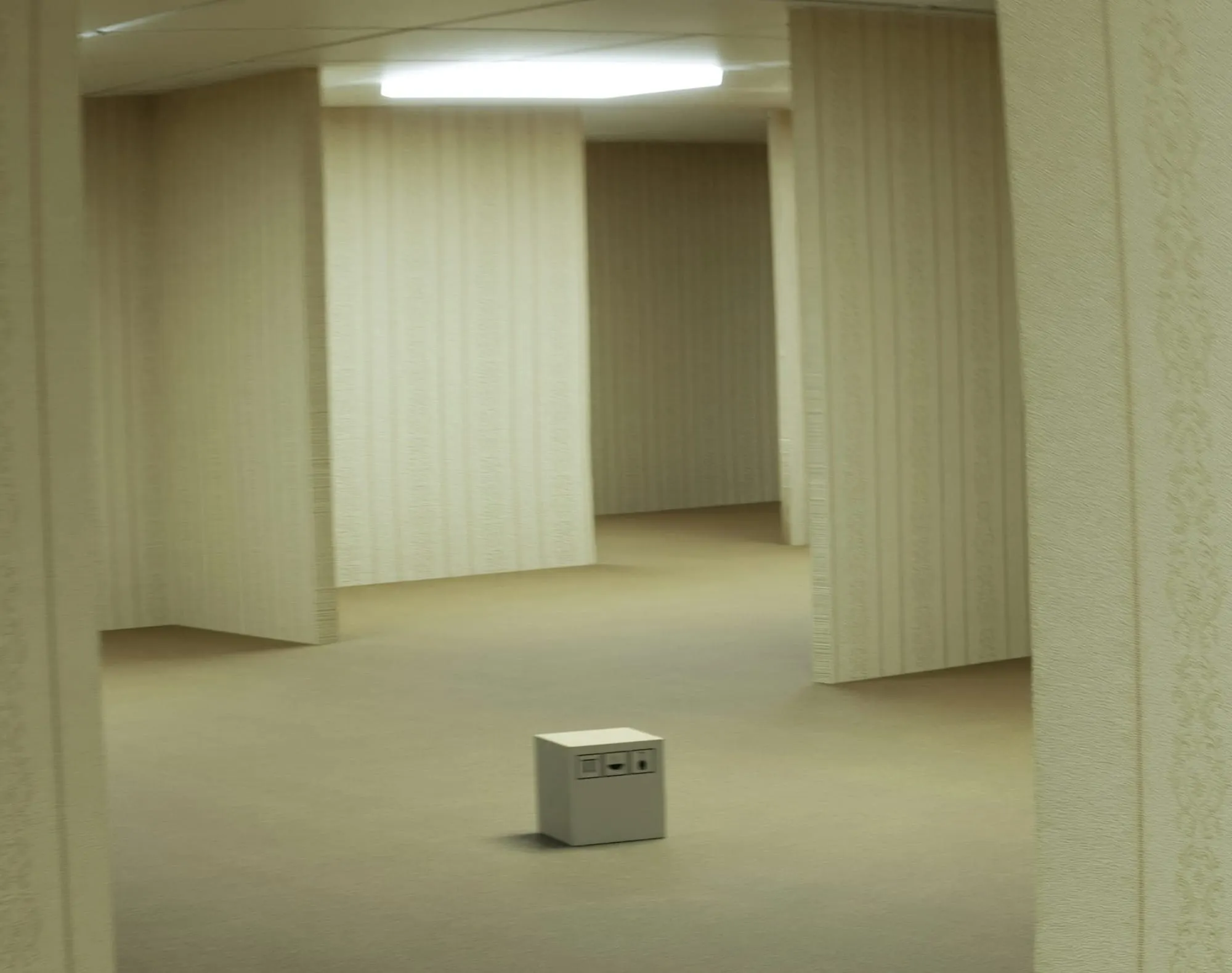
The origins of the Backrooms are now well documented. The phenomenon began with an anonymous post on the platform 4chan in May 2019. The poster shared a single image that quickly generated discussion surrounding the strange familiarity of the space and why so many users felt oddly attached to it. Although the image predated COVID-19, its popularity exploded during a period in which third spaces had largely been abandoned. The pandemic created an atmosphere hostile to social gathering spaces, allowing online communities to relate to the image in new ways.
Many users reflected on how the image resembled spaces that once appeared full of social life but now stood empty and devoid of their original purpose. The Backrooms became a symbol of absence, uncertainty, and isolation, themes that resonated strongly during the pandemic era. In 2022, the concept expanded into a mainstream cultural phenomenon through platforms such as TikTok and Kane Parsons' original "The Backrooms (Found Footage)" video on YouTube.
Many comments beneath the video focused on the psychological fear produced by the eeriness of the environment itself. Yet the fear of the Backrooms extends beyond the possibility of a lurking monster. It is rooted in the unsettling familiarity of the space and the realization that environments once designed for gathering now appear abandoned. When Parsons created the video at only sixteen years old, it is unsurprising that he gravitated toward concepts of liminal space. For him, and for many members of Gen Z, adolescence unfolded during a period marked by the decline of third spaces and growing anxieties surrounding social interaction. The Backrooms captures these fears by transforming familiar communal environments into empty, endless landscapes.
Now in 2026, the film's release has become one of the most anticipated cinematic events of the year, particularly among young audiences. Many theaters have seen a resurgence in attendance as viewers return to experience a story they have followed online for years. The film centers on characters grappling with what it means to be alone, away from society, and how the paralysis of social exchange can lead to the comfort of routine, even when that comfort comes at a cost.
The Backrooms reveals something deeper about the psychology of an entire generation. Its popularity suggests that Gen Z continues to be interested in stories that explore isolation, uncertainty, and the changing nature of public life. The film's success may also point toward a broader trend among young filmmakers, whose work increasingly reflects the social realities of growing up during and after the pandemic.
The Backrooms is interesting in many ways, to say the least. As an online horror concept turned feature film, The Backrooms mirrors predecessors such as Slender Man (2018), which, nearly a decade later, can safely be considered an unsuccessful adaptation of internet horror culture. Yet The Backrooms succeeded where many similar projects failed. Rather than providing audiences with a singular interpretation of its world, the film invites viewers to explore the Backrooms through their own understanding of the space and what it represents.
In an unexpected way, the film encourages audiences to reconsider the third spaces around them. A movie theater itself, a location filled with the ephemerality and liminality that the Backrooms captures, has increasingly become a place characterized by diminished social exchange. By presenting viewers with familiar spaces stripped of their original purpose, The Backrooms invites audiences to reconsider their relationship with public space. The film's greatest irony is that a story about the disappearance of third spaces requires audiences to return to one. Gathered together in a movie theater, viewers collectively confront a narrative about isolation, transforming the act of watching the film into a subtle reaffirmation of the social spaces it seeks to preserve.