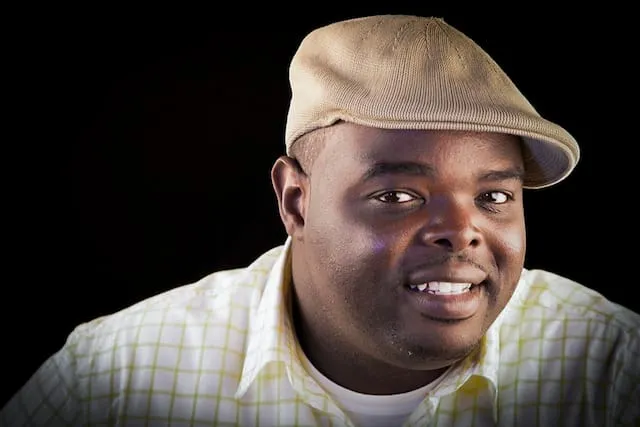
Jacquil Constant is an award-winning artist, filmmaker, curator, professor, and an activist—just to name a few standout roles from his long list of impressive achievements. Within that list is Constant's coveted title of founder and executive director of the Haiti International Film Festival.
Inspired by the vibrance and authenticity of Haitian stories and art, Constant established the HIFF to uplift fellow creators and showcase their shared culture. This August, the festival celebrates its 11th year and counting.
I had the distinct pleasure of interviewing Jacquil Constant last week and discussing his vast creative portfolio and social mission. And after speaking with this talented, insightful, and generous individual, I myself felt uplifted by his own story of ambition and triumph.
This interview has been edited for length and clarity.
I was hoping you could begin by introducing yourself and the work you've done. Could you speak a little bit about your creative journey and how your experience has influenced your mission as an artist?
It started with just a passion of telling different stories that I didn't see on the screen. And being raised in Hollywood, I didn't see too many positive images of the black community, or specifically the Haitian community. So that's why I started Constant Production back in 2006, when I graduated from [California State University], Northridge. I was a Pan-African Studies major, and I was a Cinema major.
I had my thesis film, Haiti is a Nation of Artists. It's about Haitian artists creating transformational art after 2010, and showing a different image of Haiti; that we have a rich culture, history of the arts. And at first it was a short, then I went back to Haiti three, four more times to shoot the documentary. I think that just completely changed my perception, and it premiered at Cannes through Pavillon Afrique in 2022. That was a dream from film school from '02.
What was it like to see it evolve from a documentary short to a full-length feature?
I think my creation got really strong because I went to Haiti. It made me become more passionate and really showcase the real Haiti, and not what the mainstream shows of Haiti.
That was the impetus that even started the [Haiti International] Film Festival: It was meeting filmmakers, and shooting Haiti is a Nation of Artists, and realizing, "Oh, there's a bigger community aside [from] me that wanted to go and rediscover Haiti after the earthquake." I think there was a generation of Haitian American filmmakers that wanted to experience Haiti, not the stuff that they saw on the late night news.
And meeting people that were like you, I think that was very liberating to me [and] other filmmakers. Like, "Okay, then this voice, this message is bigger than myself. There's a whole community of filmmakers in our audience that wants to see these authentic narratives."
I was wondering how you find the balance between celebrating this unique cultural heritage through film while also making art that is universally accessible. Or do you see them as one and the same? Like, if a film is done well, it can do both of those things?
It could be both of those things. Actually, a professor gave me that advice. The more that you make the film authentic, it's going to go to a larger audience. That's what I focused on on Haiti is a Nation of Artists. And I think my perspective from being from California was global from the inception.
I was not just trying to show the "upper class artist": I wanted artists that were cutting-edge, that were saying something... I was looking for my contemporary Basquiat. I wanted to debunk the myth that [Haitians are] naive. And so if I want to say something to the contrary, I had to show these amazing artists, show their work, and get their authentic voice.
Another great thing for me, an asset, [was] that my mom came [to Haiti]. So I could just be a filmmaker and shoot. Her Creole was better than mine, of course. Haitians have a deep reverence for their elders, especially mothers, so having her there, people saw that the project was serious and it brought a certain amount of gravitas. They really opened up because they felt like it was not just me as a filmmaker, and not coming with just a Western point of view or having any exploitative intentions. She had family there so connecting with them and having her with me to open some doors and explore our roots together was really special. My mom, rest in power, passed almost a decade after that trip and it was her wish to be buried in Haiti. The work that I do is also a way to honor her.
You have spoken a lot about the media's portrayal of Haitians and the nation of Haiti. What do you hope for the future of Haitian representation in entertainment media and other types of media?
I just want people to tell their authentic stories. I think that inspires people.
I showed my film [Haiti is a Nation of Artists] at Pasadena City College. Most of my students have never seen a Haitian story or seen Haiti portrayed in this way. Or when I show other films from Haiti and the African Diaspora, they're shocked because they only have this very limited view of Haiti or the African Diaspora.
I felt like the platforms that I do have as an educator, executive director of the film festival, or as a filmmaker [showcase] unrepresented communities, let them be at the center [rather] than at the periphery; to give voice to the voiceless, in a sense. That empowers me too as a filmmaker.
Those platforms are very important, especially now. I wanted to pivot a little bit to talking about the Haiti International Film Festival. How exactly did that journey begin?
In the beginning, you're just trying to get through the first year. You learn how to curate better for your audience. Having a place, a home for the Haitian diaspora to showcase their films, and the African diaspora, I think that was just really important.
It's such a fulfilling moment to see other filmmakers showcase their film and their art, because essentially you're a “placemaker”... And you bridge that gap between more mainstream and culture-relevant films. Just know that you have to give the same marketing and promotion you would give a mainstream film, but if it's indie, you're going to have to give more.
Did you ever see the festival coming this far?
I always say, "Do you want to make a slow-cooked meal or microwave?" And that's what we do: we make a slow-cooked meal. And a lot of these films, especially the features, take these filmmakers 10 years [to make]. They take them a long time. But I think when they're finished, it's something that they want to share with the community.
It's a great experience just seeing these films out now. They're at Cannes, they're at Sundance, and they showcase at our film festival, too. And the other mentality I had, I didn't want the film festival to be a one-off. I wanted the filmmakers to bring their second and third films, and that's happened; because of the way that we treat our filmmakers... just trying to respect every block, and understand what it takes for these filmmakers to make their films.
So that's been an evolution. I'm really proud of what the Haitian diaspora's doing.
Could you highlight a standout quality that sets this year's festival apart from other years?
This year is "Konnesans: The Art of Knowledge in Haitian Cinema." We want to showcase that it's the strength, it's the history, it's the knowledge that we as a culture bring.
We're actually going to make decisions pretty soon on the films that we're going to select. We're really excited to go through all the films. And it's a whole day, from 12pm to 10 o'clock, that we'll be at the Barnsdall Gallery Theater showing amazing Haitian films. And we have awards: we have a Haitian Diaspora Award, a Haitian Community Award, and we have a Haitian Ally Award this year—it's a new addition.
We get Haitian food catered, too. We try to make it a whole cultural experience and celebration, and make it a safe place for creatives... I think that's really important, that they feel heard and seen.
I think cultural celebration is a perfect description of the festival. Do you have any advice for future filmmakers who want to create a space that's safe for people of different cultures, from different backgrounds?
You have to really be passionate. And anything that you think you know, throw it out. What you think about filmmakers, throw it out. You're like, "You can't tell the story in two minutes!" and they'll shock you.
I think we have our own biases. But you have to be open because you never know what these filmmakers are gonna create. So I don't put any restrictions on filmmakers when they send me films.
And just be patient. 'Cause I think a lot of times, when people start film festivals, they think they're gonna be [at] Sundance in year one. Well, that takes a long time. Robert Redford, he did [Butch Cassidy and the] Sundance Kid before he did Sundance, right? Sometimes, we just have to be a little more patient and realistic.
Work on your strengths, and [don't] always emphasize your weaknesses. I think that's really important.
Patience and being forgiving to yourself: I think that's paramount, especially for this new generation of filmmakers, where a lot of things are about perfectionism and competitiveness. Your festival is all about the celebration of one another and your diverse experiences—and I think you and your team are doing an incredible job.
Teamwork makes the dream work. That's the thing that we always say around HIFF.
We have Cliff [Decatrel]. Cliff is an expert Oscar and Emmy Award [winning] producer. So just having him there—having Béchir Sylvain, he's one of our actors, and he's a host. He's in mainstream Hollywood movies like Jurassic World [Rebirth]... Dr. Petrouchka [Moïse] is a professor at Grinnell, is an expert on Haitian art and museums... Alain Martin, he's [an] award-winning filmmaker (The Forgotten Occupation).
I have people in different regions. Alain is on the east coast in New York. Cliff is in LA. Dr. Petrouchka's in the Midwest. So not only do we curate, we're curating the country. She has the ear to somebody in the Midwest, he has the ear for somebody on the East Coast, and we have an ear for people on the West Coast.
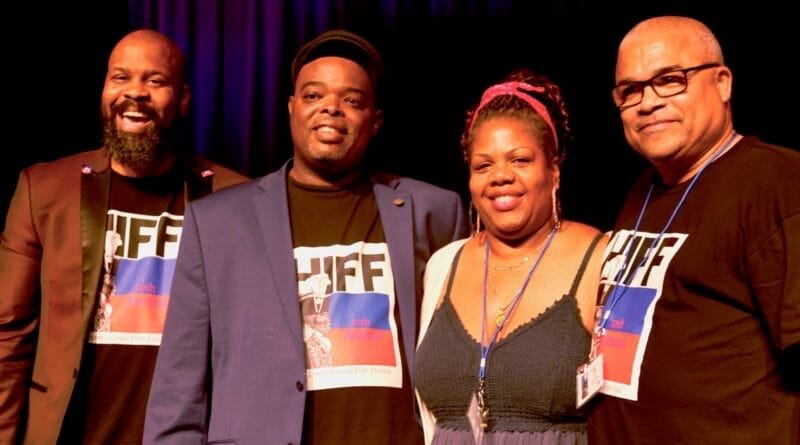
HIFF board members from left to right: Béchir Sylvain, Jacquil Constant, Dr. Petrouchka Moïse, and Cliff Decatrel. (Image Credits: Courtesy of Haiti International Film Festival)
Well, I don't think you could have a more qualified team to run this festival. It seems like you have the best of the best.
[When] we put all our resources together, then I think it becomes a really great program, and that's how we've gotten funding through the Color of Congress and the LA Department of Cultural Affairs. Because you need to have a good team—you can't do this by yourself—to be able to attract filmmakers and able to attract a diverse audience, too.
I was wondering if you could speak a little bit about your upcoming project about Haitian female creatives.
It's been an amazing experience, because it's totally different [from] how I did the documentary. It was predominantly men, and partly because I looked through galleries, but I’ve found Haitian women are more in educational and nonprofit spaces, museums.
If you're going to want to find their emerging voices, I have to go to the untraditional places. I've got to go through the educators that know, like, eight artists. And they'll take me to the first day of the show, so it gives me instant credibility that I'm there on their opening night.
I'm really excited about this, being able to interview these amazing women who are artists, writers, thought leaders. And some of the work is really abstract and groundbreaking.
I can't wait to hear more about that project. Best of luck as you continue on that, and for the upcoming festival in the near future. Is there anything else you would like to talk about or highlight?
I would love to shout out my board. This is the only way that this happens. Cliff, Alain, Dr. Petrouchka, Béchir Sylvain, Cydney [Prentice]... The wife, Berenice, giving me time to go do all this, to [go to] all these other places.
I'd like to give a shout-out to Thea [Pueschel]. We went to film school for 25 years, she's the thought partner for me too, and she helps run the film festival [and] supported me with the Haitian Bricolage Gallery.
I think community is everything... Once I have my community, you will reach your goals and exceed that. So I think that's the most important thing, is [to] just be passionate; push your community and they'll push you.
It is really [about] building unity. And that's what we want to do with our business organizations, and to simply have a safe place for artists. For Haitian artists and artists from the African Diaspora, just artists in general.
When you have to do it yourself, you get the cheat codes. You figure out how to maneuver. So I think just having that perseverance, I think that's the biggest thing. But you've really got to love it. And I think people feel that: when they feel there's some sincerity, you have conviction, people really gravitate to that. And that's where your funders are going to come from, that's where your supporters are going to come from. Your tribe, essentially.